

Photo by Greg L. Davis, U.S. Air Force (VIRIN: 160728-F-VV898-093), public domain.
A dizzying number of factors are impacting U.S. manufacturing companies right now. From tariffs and the USMCA, to a persistent skills gap and the rapid advancements of manufacturing technology, it is a particularly challenging time for American manufacturers.
Given so many new developments in the sector, we were curious to hear perspectives from manufacturing companies on outlook, new technology, tariffs and the future of U.S. manufacturing.
MNI invited industrial companies across the U.S. to take part in an in-depth survey on business conditions and outlook. Today, we are pleased to share the results of the survey and bring you some key takeaways.
1. U.S. Manufacturers are Generally Optimistic About the Future of Their Business
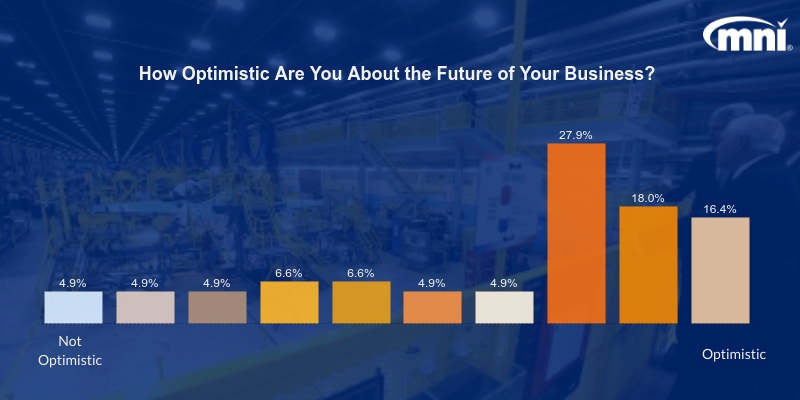
On a scale of 1-10, more than half of manufacturers surveyed expressed optimism about the future of their business. 61% of manufacturers chose the 8-10 range, with 10 being the most optimistic and 1 being the least optimistic.
The largest percentage (27.9%) chose #8.
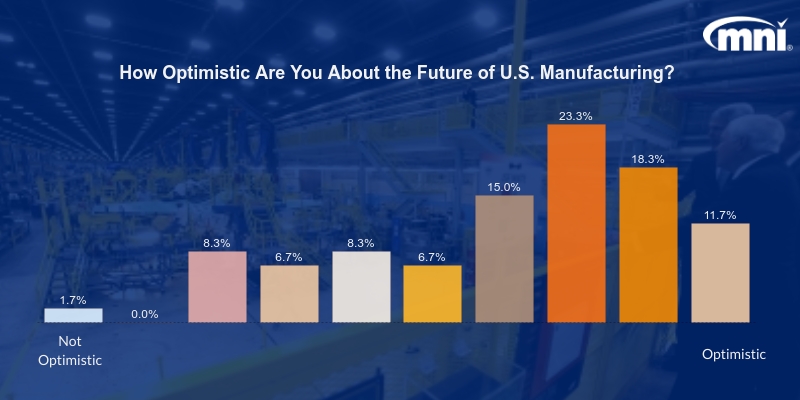
This question “How optimistic are you about the future of U.S. manufacturing?” yielded similar results, though manufacturers appear to be slightly more optimistic about the future of their own business than the future of U.S. manufacturing. A little more than half of manufacturers surveyed expressed optimism about the future of U.S. manufacturing, with 52% selecting the 8-10 range for this question.
2. U.S. Manufacturers are Divided When it Comes to Tariffs
59.3% of manufacturers reported that tariffs on imported goods from China have impacted their business, while 40.7% reported they have not.
A significant number of manufacturers who reported an impact from tariffs are in the fabricated metals and industrial machinery sectors.
Related: IndustryNet’s Top Manufacturing Stories of the Year
Those who answered “no” tended to be in the non-durable goods industries such as food processing, paper products and furniture.
3. Manufacturers in the U.S. Have a Lot to Say About Tariffs
The comments section for MNI’s survey was abloom with commentary on tariffs. Many manufacturers complained of higher prices and business costs due to tariffs, while others reported advantage over their competition and increased orders.
Said one executive in the medical instruments/related products sector: “We receive some components direct from China. In most cases, the costs are at least one level removed. Costs have definitely gone up. On the other hand, one of our price-based competitors is being hit rather significantly by importing from China.”
Another respondent in the fabricated metals industry replied: “Our customers are placing smaller orders in further apart and require shorter turn-a-round times. Their reasoning is tariff impact.”
One New York-based executive in the leather goods industry reported “Higher prices of European metal hardware” and another in the food processing industry said “We have a distributor in China and we purchase products for re-sale and our special coating for our parts comes from China. Our cost has gone up!”
A common complaint with manufacturers in reference to tariffs is the difficulty in finding domestic suppliers of various components and parts otherwise procured overseas.
Said one Nevada medical instruments company: “Some specialty monomers are only made in China. The U.S.A. no longer makes most of them.”
However, some manufacturers expressed optimism and referenced opportunities brought by tariffs. One manufacturer in Ohio said “We supply equipment to the steel industry. The tariffs and tax changes helped the industry and they are reinvesting by updating and automating.”
One respondent in the stone/clay/glass industry simply responded that [tariffs were] “very good for business.”
Another in the industrial machinery industry reported “increased material cost, but also increased domestic opportunities for machining”
One Louisiana textile executive’s comments also suggest the tariffs have served to invigorate domestic manufacturing: “Seemingly, in a positive way it [tariffs] has leveled the playing field, however small may be, in price leveraging. Current customers are trending upwardly in the % of work processed thru our facility, where once it was obviously advantageous to procure it abroad. The tariffs seem only fair against the backdrop of overseas business competitors. They may indeed have deliverables that are destined for the states, that meet the criteria of the regulatory bodies here in the states that govern over them, but it's within the administrative area of the business that our international competitors have the advantage and make it almost impossible to compete.”
4. U.S. Manufacturing Companies are Actively Looking to Procure More Domestic Supplies
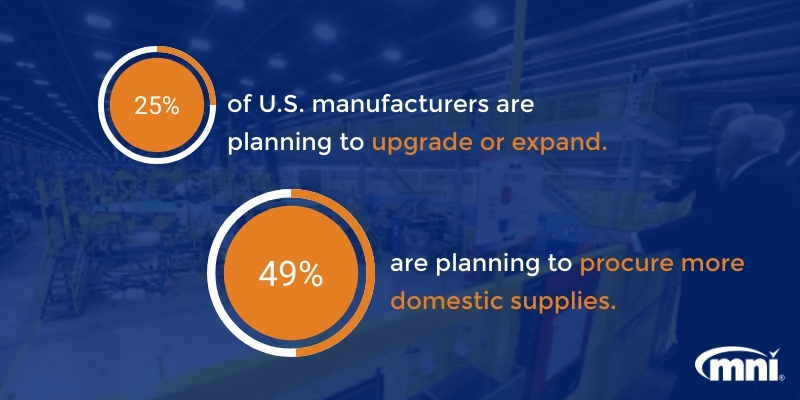
Tariffs have caused a shake-up to many a supply chain, and so we wondered: are more U.S. manufacturers looking for suppliers at home? Turns out virtually half (49.2%) of manufacturers are looking to procure more supplies domestically and 34% answered they may possibly procure more domestic suppliers. Only 16.4% replied “no” to this question.
IndustryNet, MNI’s industrial marketplace that connects industrial buyers with U.S. suppliers, reported a surge in industrial category searches and requests-for-quotes in 2019. MNI data shows a 45% increase in quote requests; a 32% surge in listing views; and a 21% rise in category searches.
5. Nearly a Quarter of U.S. Manufacturers are Planning an Upgrade or Expansion
Capital investments and upgrades are good indicators of a strong manufacturing climate, so we asked the question: Are you planning an upgrade or expansion of your facilities within the next 12-24 months? 24.6% of manufacturers said they were planning an upgrade or expansion and while another 24.6% answered “possibly”.
Nearly half (45.9%) said they did not plan an upgrade or expansion, with the remainder undecided.
6. A Notable Percentage of Manufacturers Are Considering Relocation
10% of manufacturers reported plans to relocate within the next 12-24 months. 11.7% reported possible plans to relocate within 12-24 months, while 71.7% reported “No.” The remainder were undecided.
7. U.S. Manufacturers Are Embracing Technology
Manufacturers were evenly divided when it came to the question: Are you planning to adopt new technology in the next 12-24 months? 37% answered “Yes” and “26.4% answered “Possibly”. About a third answered they were not planning to invest in new technology.
Related: Popular AI Applications in Manufacturing
Find New Suppliers in 2020 With IndustryNet
At MNI, we’re always looking to help U.S. businesses thrive, providing tried-and-true industrial solutions since 1912. Powered by trusted MNI data, IndustryNet is an industrial marketplace that helps connect industrial buyers with 400,000 U.S. manufacturers.
Set up a free account, build a list of suppliers, send quote requests, download catalogs, contact companies directly, and more.
IndustryNet is also a direct path for U.S manufacturers to increase their visibility among domestic industrial procurers.
Want to empower your sales team with MNI data? Learn more about how an IndustrySelect subscription can help you find new customers in 2020.
