

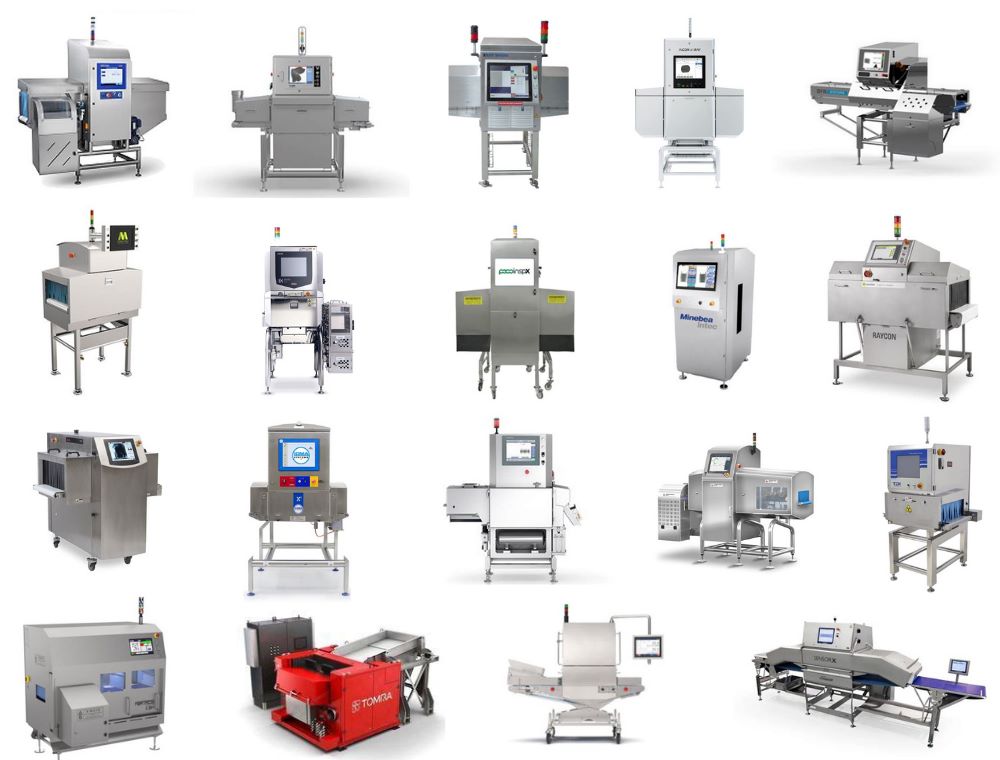
The x-ray product inspection industry is difficult to navigate. Nearly every manufacturer claims to be a global leader, and inconsistent spec listings make apples-to-apples comparisons frustrating. This guide ranks the major players on the metrics that actually matter, explains what those metrics mean, and ends with a practical framework for narrowing down your options.
Before diving in: if your application is straightforward (uniform product, metal detection only), almost any experienced supplier with the right hardware can serve you. If your application is difficult (you're detecting plastic, rubber, or very small metal), the field narrows considerably. Keep that distinction in mind throughout.
What the Rankings Measure
Companies were scored by distributors and end users with direct experience. Those without hands-on familiarity were asked not to contribute. Scores are relative to one another across six categories:
- Flexibility (customizability for specific applications)
- Performance (detection accuracy)
- Generator lifespan
- Service quality and accessibility
- Ease of use
- False reject rates
Top Five Companies
Eagle PI
Eagle pioneered x-ray inspection in the food industry and developed most of the auxiliary benefits available today, including item count, weight estimation, and package integrity checking. They were the first to apply photon-counting technology to food inspection and continue to lead in that area. Their machines are the most customizable in the field, which drives superior performance across applications but does require experienced staff or distributors to configure and optimize them properly.
The main trade-off is upfront cost, which ranks in the top 20% of the industry. Eagle argues this is offset by lower long-term costs, citing the relationship between component quality and generator longevity. Their smallest standard machine comes in at 52.8 inches but can be ordered down to 36 inches. Best suited for difficult applications and any situation where long-term performance and flexibility are priorities.
Mettler Toledo / Safeline
Mettler Toledo sits at the high end of the mid-range category. They use established, pre-set algorithms optimized for standard applications, and they execute that approach well. Sanitary designs are on par with Eagle, and their software, data collection, and modular reject options are among the best available. A universal plug interface supports a wide range of reject configurations.
The downsides are cost and access. Mettler locks equipment so only their technicians can service it, which creates higher service costs and potential availability issues. Settings adjustability is also limited as a result. Large accounts tend to be well-served because Mettler provides a structured rollout package and handles support centrally. Best suited for standard applications where simplicity and formalized support matter more than flexibility.
Aicon
Aicon was founded by Eagle's former Poland distributors and built with Eagle's architecture as the clear reference point. The similarity in the rankings reflects that. The company is new to the market with a smaller install base, but their focus on sophisticated systems and difficult applications is already showing results. A strong candidate for non-standard applications, and one to watch as their install base grows.
Anritsu
Anritsu is a Japanese manufacturer covering metal detectors, x-ray, and check-weighers. They have strong detectors, generators, and software, and handle custom applications well. The downside is that application-specific changes need to be made at their Japan facilities, which adds lead time. They were the first to respond to photon-counting technology and are expected to be the next best at it after Eagle. Cost is comparable to Eagle based on available scoring, though actual quotes are needed to confirm.
Ishida
Ishida is the more affordable alternative to Mettler Toledo, targeting simpler applications and maximizing economies of scale. They specialize in single-beam systems and perform well on low-difficulty applications, where they can compete directly with Eagle. Their product portfolio extends well beyond x-ray into labelers, desiccant inserters, and leak detectors. Ishida goes to market exclusively through Heat and Control in the U.S. Reported complaints include parts sourcing difficulty and isolated instances of receiving incorrect machines at installation.
Specialty Companies
These companies focus on specific applications rather than serving the full range of inspection needs.
Tomra
Tomra comes from the agricultural vision systems world and brings that dry bulk, high-throughput orientation to x-ray. While most bulk-focused x-ray companies top out around 30 tons per hour, Tomra handles up to 150. That scale comes with significantly larger equipment footprints. Metal detection is generally strong; glass detection, as with most systems, can be inconsistent. Tomra acquired Odenberg in 2011 and Best in 2012.
Peco Inspx
Peco Inspx is a California-based company specializing in tall product inspection, including fill-level monitors and dud detectors for bottles and similar containers. Their side-shooter x-ray systems are among the best available for this application. They also perform well in bulk applications. One noted downside is generator lifespan, with some reports of replacements needed within a year. Peco also appears to be the only supplier with a solution for continuous webs of packets or pouches fed directly into the machine.
Marel
Marel focuses on the meat industry and covers weighing, processing, and inspection. X-ray is not their primary focus across the board, but they have the meat application well covered. For applications requiring belt widths above 2.4 feet, Marel is currently the strongest option available, as Eagle's PXT integration for their largest bulk machine is still in progress. They are reportedly the most expensive option in this category by a wide margin.
Foss
Foss is a meat analysis company that uses x-ray primarily for fat analysis rather than contaminant detection, though they do both. They are the closest competitor to Eagle in FA performance and are reportedly the only other company capable of handling frozen blocks and cartons, with capacity up to 7.87 inches in height versus Eagle's 7-inch standard. List pricing is higher than Eagle with significantly higher service and parts costs, though upfront costs are often discounted.
Additional Companies
Sesotec
Sesotec functions as a more affordable alternative to Mettler Toledo and Ishida. Machine quality and detection performance have historically lagged, though recent reporting from distributors suggests meaningful improvement. Free startups and ease of use are noted advantages. The company is German-founded and does a significant portion of manufacturing in Asia.
Wipotec
Wipotec offers good sensitivity at competitive cost with strong software and data collection. Their machines are easy to use and modular, with the ability to attach check-weighers or vision systems. Dual energy has not been confirmed in the field but a press release suggests it may be forthcoming. A 200W variable energy generator is available.
TDI Packsys
TDI Packsys entered food x-ray from the security inspection world with significant resources behind the move. Their machines are entry-level with average line speeds, but dual energy is included and applied well. Reported downsides include difficult operation interfaces, high maintenance costs, and mixed service reviews. On the positive side, they maintain a large catalog with many units in stock and a plug-and-play setup experience.
Loma
Loma is a mid-range manufacturer with a substantial number of machines in the field. Dual energy appears to be new for them as of mid-2025. Machines are neither high-end nor entry-level in build quality. Service costs can be high depending on technician proximity, as billing originates from the technician's home address. Known for accessible pricing, strong stock availability, and ease of use for entry-level buyers.
Thermo Fisher
Thermo Fisher makes x-ray but offers limited options with no meaningful customization. They use 0.8mm detectors (0.4mm optional) with single energy only. Generator wattage is 900W for heavy-duty units and 500W for smaller ones. These machines suit operations that need x-ray as a checkbox without significant detection demands. No field feedback was received on service experience.
Others
Fortress has recently entered x-ray from a strong metal detection background and is currently focused on basic applications. Minebea, a high-end weighing equipment company, has made early x-ray products that have not yet demonstrated strong application results. Mekitec (Finnish, manufactured in China) uses AI image analysis but faces speed limitations as a result. Cassel is a German specialist for extremely wide, flat products like cardboard and fabric with detection area widths up to 126 inches. Antares is a vision company that recently introduced what appears to be the only gravity-drop x-ray system on the market.
How to Choose
For Standard Applications
Most experienced suppliers with the right hardware will deliver acceptable results on simple, uniform products where metal is the primary contaminant. Focus your evaluation on detector resolution (0.4mm is standard; 0.2mm and 0.1mm are available with corresponding line speed trade-offs), generator wattage and warranty, local service availability, beam count if density-similar contaminants are a concern, and testing on your actual product.
For Difficult Applications
If you are detecting plastic, rubber, or very small metal in products with variable density, the field narrows to the high-flexibility companies. Testing on your product is not optional. Performance will depend on company and technician experience with your specific application, algorithm capability, and software optimization. If budget allows, starting with Eagle and testing others against them is a reliable approach that saves time.
About ABM Equipment and a Note on the Rankings
ABM Equipment engineers, fabricates, installs, and services systems for handling, processing, packaging, and inspection across a wide range of products, primarily food. Because x-ray inspection is frequently part of the systems ABM builds and services, the company has developed hands-on familiarity with equipment from many manufacturers over the years. That experience, combined with ongoing work as a distributor and rep for select brands, forms the basis of the rankings in this guide. Learn more at www.abmequipment.com
In the interest of transparency: ABM Equipment is Eagle's primary distributor in the Northwest and a Mettler Toledo rep nationwide. The company's position is that this represents an alignment of interest rather than a conflict. Eagle ranks at the top of this guide because of performance results documented over years of field work, competitive testing, and customer feedback, not because of the distribution relationship.
A useful illustration: one of ABM's global customers, a top-five food producer managing hundreds of lines, ruled out Eagle on cost grounds from the start of their evaluation. They conducted their own research, ran tests with the leading companies, and ultimately invited ABM for a head-to-head comparison against the strongest alternatives. After factoring in replacement part costs and false reject rates, the data pointed in one direction. The rankings in this guide reflect that kind of experience.
