

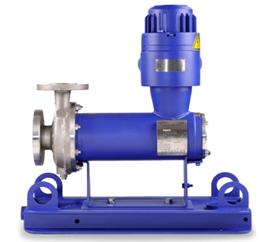
Almost every industry has high temperature applications (hotter than 300°F). There have been a number of alternatives that plants could use that can handle their high temperature applications. The traditional means of handling these hot fluids was using a pump with single or double mechanical seals and use some elaborate seal cooling. However, for over 30 years now, there have been two pump technologies that are better suited to handle these hot fluids from an operational and maintenance standpoint; magnetic driven pumps and canned motor pumps.
Once we start dealing with liquids at temperatures of over 600°F we find that seals are no longer a viable option once you consider maintenance costs and pump reliability.
The challenges faced at higher temperatures have increased over the years which is forcing the end users to seriously consider best practices for pumping any hot liquid.
What Challenges Are We Facing When We Have To Pump Hot Liquids?
Hot liquids present a number of challenges to both the plant and the engineers who have to design build and commission any line transferring hot liquids.
It is virtually impossible at higher temperatures (above 600°F) to find mechanical seals that actually work. When one can be found the seal requires an external source of cooling for the seals and the bearing which in turn translates into extra capital costs and extra maintenance over the life of the pump.
Mechanical seals will eventually leak, even when finding a seal that will last longer in a high temperature environment.
Minimizing Operating Costs
Between 40% and 60% of the total cost of ownership of a pump will be maintenance and power costs. The ongoing operating and maintenance costs can be even higher if the system isn’t built to keep operating costs to a minimum. Using any pump outside the optimal zone on their efficiency curve can drive up operating costs and hot liquid applications are no exception.
Meeting Industry Regulations
Hot liquids applications are found in nearly every industry. You need to be sure that the pump selected complies with your industry’s and EPA regulations. It is a good idea that everyone involved in the system design and operation is aware of what regulations must be complied with.
Mitigating Safety Risks
Any time hot liquids leak the resulting shutdown and downtime are expensive enough, however the health and safety inspectors can make it that much more expensive. Minimizing the risks when pumping hot liquids has to be seen as wise business management, smart engineering and a secure investment.
Your plans to minimize leaks start at system design and pump selection and needs to be included in Total Cost Of Ownership calculations.
Making The Most Of Your Available Space
Space is becoming a more and more valuable commodity. The different classes of pumps you can use to pump hot liquids have very different footprints. Even if you have the space to accommodate a larger pump one day it might turn into an extravagant investment.
Managing Downtime AND Preventing Breakdowns
Mechanical seals eventually leak – even ones specifically designed to handle the higher temperature. Seals are almost always the no.1 cause of failure on any pump. Seals fail faster when pumping hot fluids- which means that using mechanical seals is a recipe for having to deal with more down time, deal with more clean ups and doing more preventative maintenance.
With all the drawbacks associated with choosing mechanical seals many plants are looking for alternatives to reduce downtime and prevent having to clean up a spill every time a seal fails.
What Is Best Practice For Pumping Hot Liquids?
In the past the choices for pumping hot liquids have been between mechanical seals and using mag-drives or canned motor pumps. Mag-drive pumps capabilities are very limited because they cannot operate in temperatures above 450F. Pye-Barker’s review of the market for best practices and products in the field of pumping hot liquids has led us to conclude that canned motor pumps are the best option for pumping hot liquids because they best address the challenges faced by plant operators who need to pump hot liquids.
- Canned motor pumps circumvent all the costs and difficulty sourcing seals that can perform in very adverse conditions. They are very cost efficient to operate over their lifetime.
- Canned motor pumps offer dual containment of the liquid being pumped which means there are no catastrophic failures and liquids escaping into the atmosphere. The close coupled design means there is no alignment of the pump required.
- Canned motor pumps can handle fluids up to 662°F with no auxiliary cooling water and up to 850°F with cooling.
- They are extremely quiet when operating
- Their compact design means they occupy a very small footprint.
- Sizes up to 3x2x10 available with ANSI dimensions.
- They are the perfect example of a low maintenance pump with only two bearings, O-ring and sleeve which typically last for years before requiring a service.
Based on our survey of the market we believe the best canned motor pumps on the market are Lewa-Nikkiso Canned Motor Pumps.
Why Choose Lewa-Nikkiso Canned Motor Pumps?
Bearing Wear Monitoring
The main reason Lewa-Nikkiso pumps offer the best canned motor pump in the market is the fact that all their pumps are fitted with a bearing monitor. This bearing monitor is the only one available the market that measures the axial and radial movement of the rotating assembly, which means constant monitoring of the bearing wear in both planes. Thisallows either you or our maintenance team to plan for pump
maintenance at a convenient time rather than waiting for the bearing to fail and cause an unplanned outage to stop the process most probably at the least convenient time.
Special Pump Design
Directly integrating the hermetically sealed motor with the centrifugal pump does not only ensure environmental protection, but also safety at the plant. All parts of the pump are also designed for easy and fast maintenance. Therefore, you can minimize unproductive down times.
Very Good High-Pressure Characteristic
The NIKKISO Non-Seal centrifugal canned motor pump is available in multi-stage version to handle high pressure applications. Therefore, it is ideally suited for high pressure transfer and circulation applications of critical or hazardous fluids.
High Serviceability
Since the process fluid lubricates the bushings and dissipates the heat generated by the motor, no additional lubrication is required on most applications. This gives the pumps a high degree of serviceability.
Small Footprint
Due to its compact design the canned motor pump needs very little space and is ideal for applications in which a small footprint is required.
Quiet and Low-Vibration
The pump is quiet and has low vibration. It is extremely weather-resistant and has good dust protection.
Low Maintenance Costs
The pump’s low maintenance costs are due to the relatively low number of wear components and the real-time monitoring of the bearing wear.
What Applications Have We Used Canned Motor Pumps For?
We’ve successfully used Canned Motor Pumps to move the following classes of hot liquids: Organic Liquids such as Dowtherm® and Therminol®
- Hot Oils such as Umblethem,® Caloria,® Mobiltherm® and Shell Thermia®
- Silicone Fluids
- Molten salts
Canned Motor Pumps can also be used very effectively in the following applications:
- Products with poor lubricity (0-3pH range), like sulfuric acid, Hydrochloric acid, etc…
- Products that crystalize at the seal faces (caustic in the range of 10-14pH), like sodium hydroxide, potassium hydroxide, etc
- Applications that require seals with complex cooling plans for seal flushing (very costly).
- Very toxic or lethal chemicals
- Control emissions on 149 volatile organic compounds as part of the Clean Air Act enacted by EPA in 1990.
- All kinds of refrigerants.
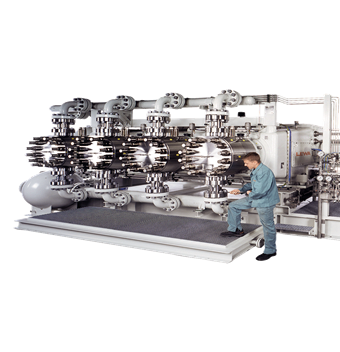
About Pye-Baker’s Pumps Consulting, Supplying And Installation
Pye-Barker can advise you on the design, specification of any hot liquids processes, provide all the parts for your pump, install and maintain them for you. With 150 years of positive displacement engineering experience. There isn’t an application we haven’t had direct experience with already and worked out how to make it work for our clients.
Offering a comprehensive range of both centrifugal and positive displacement pumps in a variety of construction materials, Pye-Barker can find a pump that will pump even the most corrosive or abrasive materials without frequent outages or requiring continual maintenance.
Pye Barker specializes in managing the entire process of designing, building and repairing pump systems so that their clients never have to worry about them during any part of their lifecycle.
All Pye-Barker designs that are built and installed by Pye-Barker are guaranteed to get the specified performance, otherwise Pye-Barker will guarantee to keep working with you until your pump system works as specified even if it means installing a whole new pump.

What To Do Next
If you are planning to build, upgrade or add a pump system, the first step to getting the right performance is a no-cost, no-obligation “Design Needs Assessment.” To schedule your “Design Needs Assessment” call 404-363-6000, or send an email to sales@pyebarker.com or go to https://pyebarker.com/pump-quote/
