


Economic indicator reports released in July reveal the U.S. manufacturing sector continues to experience a mix of both hopeful and challenging developments. Despite facing diminishing demand and supply chain complexities, the sector has shown resilience and potential for improvement. Today, we're exploring regional performance, manufacturing output and capacity utilization, manufacturing construction spending, and more in our roundup of the most important manufacturing business reports released in July.
Executive Summary: Economic Indicators for U.S. Manufacturers (July 2023 Roundup)
• U.S. manufacturing output decreased slightly in June, down 0.3%.
• Manufacturing activity contracted for an eight consecutive month in June, the longest run of contractionary readings since the Great Recession.
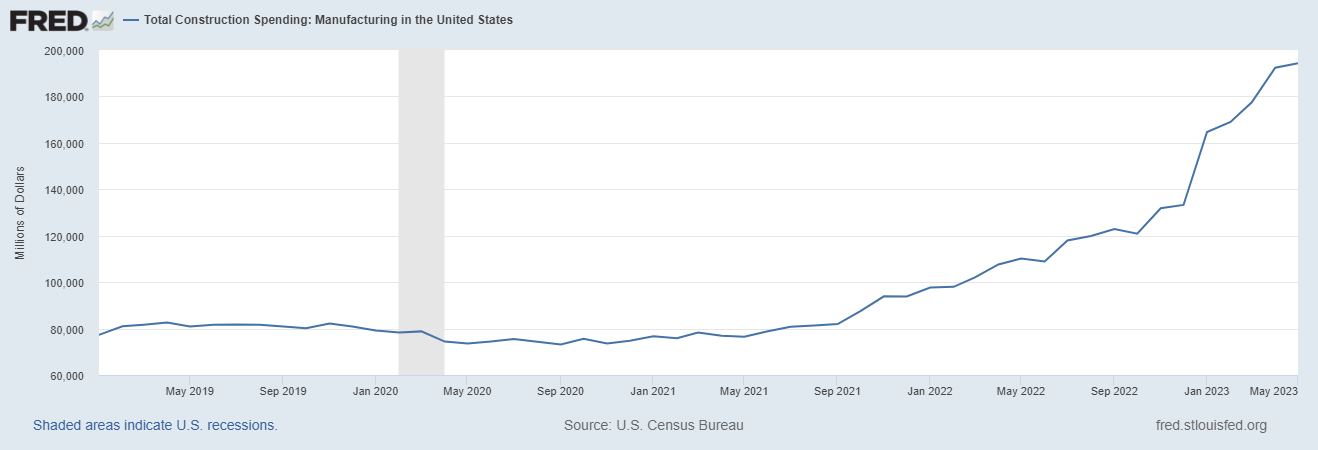
• Manufacturing construction has skyrocketed over the past several years, with spending on construction of new facilities rising 140% since May 2019.
• Regional surveys continued to be subdued, with the exception of the New York region, which showed the most improved business conditions.
• Hiring in the U.S. manufacturing sector rebounded in June, adding 7,000 jobs.
• The automotive sector continues to lead employment gains, adding more than 17,000 jobs over the past two months.
• The number of unfilled manufacturing jobs in the U.S. continues to decline, though open positions are still at unusually high levels, compared to historical numbers.
Manufacturing Output Eases in June
After ticking up just 0.1% in May, U.S. manufacturing output eased 0.3% in June, according to the Federal Reserve’s Industrial Production and Capacity Utilization report released July 18th. Meanwhile, the index for mining decreased 0.2%, and utilities declined 2.6%. The Fed’s overall industrial output index for June declined 0.5%.
Meanwhile, manufacturing capacity utilization declined to 78%--0.2% below its long-run average.
Related: How Outsourced Industrial Prospecting Can Help Your Manufacturing Company Survive Uncertain Times
Industries seeing an increase in capacity utilization included primary metals, machinery, textile mills, chemicals, and paper products, while industries that experienced a decline in capacity utilization include nonmetallic mineral products; plastics and rubber products; printing and related support activities; and wood products.
Most U.S. industrial sectors posted marginal losses in output in June, with the exception of wood products, which grew by 1.9%; miscellaneous durable goods manufacturing, up 1.8%; aerospace, up 1.6%; and computer and electronic products, up 1.3%.
Output declines were widespread but minor, with the sharpest decreases seen in transportation equipment, down 3%; textile and product mills, down 2.9%; printing and support, down 2.5%; apparel and leather products, down 1.7%; and petroleum products, down 1.6%.
U.S. Manufacturing Employment Rebounds from May Losses
Following a 2,000-job loss in May, manufacturing employment in the United States increased by 7,000 jobs in June, according to the latest report from the U.S. Bureau of Labor Statistics.
Transportation equipment overwhelmingly led June’s manufacturing jobs gains, with the sector adding 7,200, adding to a 10,500+ job gain in May. Meanwhile, navigation and measuring instruments, machinery, and nonmetallic mineral products also posted significant gains.
These gains were offset by widespread job losses in non-durable goods manufacturing, sharpest in food manufacturing (-3,300); plastics and rubber manufacturing (-2,000); and printing/related support activities (-1,500).
Meanwhile, the latest JOLTS (Job Openings and Labor Turnover Survey) reported the number of unfilled job openings in the sector is now at 579,000. While this number is still elevated compared to historical numbers, the number of unfilled job openings has fallen significantly from one year ago.
Manufacturing Construction Spending up 140% in 4 Years
The latest from the Census Bureau finds that construction spending in the manufacturing sector continues to rise significantly. Construction spending on new manufacturing facilities has increase 140% over the past 4 years, with manufacturing spending seeing a spike in the post-pandemic years. Spending on new manufacturing facilities now far exceeds pre-pandemic levels, with $80 million spent in May 2019 compared to $194 million in May 2023.
Manufacturing Posts Longest Stretch of Contraction Since Great Recession
Meanwhile, the U.S. manufacturing sector posted its eighth straight month of contraction, according to the latest survey by the Institute for Supply Management released July 1st. The ISM reports its index of manufacturing activity fell another 0.9% to a reading of 46%. This stands as the sector's longest stretch of contracitonary readings since the Great Recession.
Although contraction was widespread across multiple metrics, one possible bright spot was a drop in Customers’ Inventories, a “positive for future production,” said Timothy Fiore, Chairman of the ISM.
Demand remained soft, but improved slightly in June. The ISM’s New Orders index rose 3% to a reading of 45.6%, demonstrating that new orders are contracting at a slower rate compared to May.
Employment fell back into contraction after rebounding in May, while output fell further, down 4.4% to a reading of 46.7%. Just four of eighteen industries surveyed by the ISM reported growth in June. These were printed and related support activities, nonmetallic mineral products; primary metals; and transportation equipment.
Related: Selling in a Downturn: Opportunities & Best Practices
Regional Surveys Subdued
New York Manufacturing Survey After rebounding from contraction in June, manufacturing activity in the New York region remained steady. The general business conditions index decreased to 1.1, indicating little change. New orders slightly increased, shipments expanded at a slower pace, and delivery times shortened. Employment levels saw a slight increase, while the average workweek remained unchanged. Price increases moderated, with both prices paid and prices received indices falling. Looking ahead, firms expect conditions to improve, but optimism remained muted, as reflected by a decline in the index for future business conditions. Capital spending plans also remained weak.
Richmond Fed Manufacturing Survey Manufacturing activity in the 5th District, which includes Maryland/D.C.; North Carolina, South Carolina, Virginia and most of West Virginia, also showed little change. The composite manufacturing index increased from -15 in May to -7 in June, with improvements in shipments and new orders, although both remained below zero. The employment index slightly declined from 5 to 2. Firms were less pessimistic about local business conditions, with the index rising to -8, and the index for future local business conditions also increased. Reductions in orders backlogs and vendor lead time were reported by many firms. Spending indexes showed an increase, while the growth rates of prices paid and prices received decreased, with expectations of further moderation in the next 12 months.
Kansas City Manufacturing Survey. Factory activity in the 10th district (encompassing Kansas, Colorado, Nebraska, Oklahoma, Wyoming, northern New Mexico and Western Missouri) continued to decline in June, and expectations for future activity turned negative. The month-over-month composite index decreased to -12 from -1 in May, with both durable and non-durable goods being affected, particularly primary metals and print manufacturing. The pace of decline accelerated compared to May, with various indexes such as production, shipments, employment, supplier delivery time, and inventories all declining at a faster rate. Year-over-year factory indexes also decreased further, and the future composite index reached its lowest level since April 2020, dropping from 2 to -2.
Texas Manufacturing Outlook Survey According to the Texas Manufacturing Outlook Survey, Texas factory activity declined in June. The production index fell to -4.2, indicating a slight contraction in output. Other indicators also pointed towards contraction, with the new orders index remaining negative at -16.6 and the shipments index plunging to -17.0. Perceptions of business conditions worsened, although there were slight improvements in the general business activity and company outlook indexes. Labor market measures showed weaker employment growth and declining work hours. Price pressures decreased, while wage pressures remained elevated.
Find and Attract New Business in the Industrial World with MNI
Powered by trusted MNI data, IndustryNet is an industrial marketplace that connects industrial buyers with 400,000 U.S. manufacturers and suppliers of more than 10,000 types of products and services. Set up a free account, search for suppliers, send quote requests and more with this free industrial marketplace.
IndustryNet is also a direct path for U.S manufacturers to increase their visibility among domestic procurers. MNI also makes it easy for industrial companies to expand into new markets. Click here to learn about how an IndustrySelect subscription can help you develop the right pool of leads for your product.
