

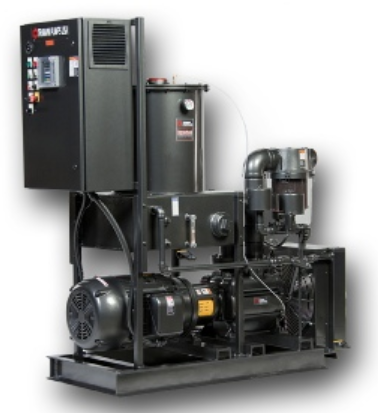
 We’ve all had our share of high maintenance costs, high downtime, and performance issues with our vacuum pumps in the past and no doubt we expect them to occur again tomorrow.
This doesn’t need to be the case.
Like any other positive displacement technology, vacuum pumps can be run with lower maintenance costs, low downtime and still perform to specification.
When you consider that 40-60% of the total cost of ownership is after the purchase – it makes a lot of sense to factor in the maintenance costs, uptime, performance and power consumption into a decision to when making major investments in your vacuum pump systems.
The key challenge remains in getting the specification right in the first place.
Supplying the right information to the product supplier and the specifier is critical to getting the equipment that can actually handle the task.
When it is assumed that the gathered information is accurate and it’s not, it can lead to undersized pumps being installed which creates flow rate problems.
Where preexisting piping will be used, a thorough leak detection is required.
Existing leaks can increase the demand on the vacuum pump for it to perform as required.
If the leak isn’t fixed the end user can experience decreased flow rates in their application or increased power consumption, increased ‘wear and tear’ which can lead to higher than forecast maintenance costs.
Once we are sure that the specification is accurate then the next challenge becomes getting the components to interface with each other and with any existing control systems currently operating on the line.
Compatibility can be a source of endless frustration where builds become delayed and completion dates are pushed out.
This is an issue that should be addressed in the design phase in consultation with the system provider and the supplier. They should have a good understanding about compatibility and this helps you avoid these delays.
Any time that a vacuum pump is forced out of the sweet spot on its performance curve, power consumption goes up – which generally is not a big deal – given the power costs to run a vacuum pump.
What is a big deal is that downtime goes up and maintenance costs go up.
Of the two, downtime is far more expensive once you factor in the costs of lost production as well as the costs of the repairs themselves.
In some ways these concerns are timeless for the market, however iterative improvements in technology are creating options that weren’t around previously.
What Are The Available Options For Vacuum Pumps?
Before we dive in we do need to take a little bit of time to define a couple of key terms. Manufacturers have a couple of key measures they are used to rate their machines.
They are important for getting the specification right and being sure your vacuum pump system will provide the required flow at the required pressure.
The first is pressure, which is a measure of how strong the vacuum is. This is most commonly is measured in Gauge Vacuum (HgV), a scale that starts at 0” representing atmospheric pressure and goes to 29.92” a perfect vacuum.
There are four categories of vacuum pressure that commercial vacuum pumps fall into
• Low Vacuum (LV) – up to 3” HgV.)
• Medium Vacuum (MV) – ranges between 3” HgV. To 16” HgV.
• High Vacuum (HV) – ranges between 16” HgV to 25” HgV
• Ultra-High Vacuum (UHV) – 25” HgV to 29.9” HgV.
Other measures of pressure include HG. Absolute, Pascals, millibars and Torrent or Tor. Don’t be surprised if you see pressure talked about in multiple measurements. Break out your units converter if you need to use these.
The second measure is flow rate, a measure of how much air/gas is displaced by the machine in minute. It is a measure of how much vacuum is created.
Flow is either measured in Inlet Cubic Feet Per Minute (based on an idealised air pressure/altitude, actual inlet plus ambient temperature and relative humidity) or Actual Cubic Feet Per Minute which measures performance of the unit in the room where it is situated.
What Happens When We Get A Good Specification And Good Supplier Of Vacuum Pump Systems?
Without a good specification and a good supplier, your plant might be faced with maintenance issues, high unscheduled downtime, poor performance and slow build times. All of which impact on the efficiency and the productivity of the lines in question.
It can be a source of on-going frustration as productivity slows down or worse yet, grinds to a halt.
However when you get your specification right and work with a good supply company you’ll be rewarded in the following ways:
You’ll Get The Right Flow Rate – very simply your vacuum pumps will provide the right pressure and flow while operating at the optimal range of their performance curve. As long as the system as a whole is well maintained. It will continue to work until the lifecycle is complete.
Commissioning Will Be On Time – Integration of components with the control systems is a critical issue for commissioning to be completed on time. Working with suppliers who can supply products that meet your specification and know how to get them to work with each other and your control systems mean that commissioning can be a relative quick and completely painless process for you.
Low Maintenance/Operating Costs – When any type of vacuum pump is operating within the optimal range of its performance curve, maintenance will likely be just preventative/scheduled maintenance tasks which will be something your maintenance team will grateful for.
Low Downtime – If vacuum is needed on an ad-hoc basis such as in a medical facility where it might be part of procedures or continuously in a mechanical conveying process when it is not there it will grind the production to a halt when there is an outage. Outage of a relatively inexpensive piece of machinery can grind a critical process to a halt. This makes contingency planning in both equipment and parts vital.
Working with a supplier who can repair, service and have parts to you quickly, helps to reduce downtime to the bare minimum.
What Types of Vacuum Pump Are On The Market?
If you need vacuum for a line, there are typically a few choices to pick from depending on the requirements. Having a good OEM system provider or engineer working on your specification will be the best way to ensure that that the system that is finally commissioned will perform as required.
Blowers & Fans (for low to medium vacuums)
We can sub-divide this category into two main designs; Positive Displacement (PD) and Centrifugal blowers.
In PD blowers, air or gas enters through an expanding section on one side and exits through a decreasing section on the other side. They maintain a constant speed and flow regardless of changes in pressure.
You can use these blowers to move both air and neutral gases. If the discharge valve is closed, PD blowers will continue to flow and could burst the line. That’s why safety valves are crucial for this blower.
There are two common types of PD blowers; Rotary Lobe and helical Screw.
The Rotary Lobe blowers consist of two or three rotors spinning in opposite directions. The blower sucks in air, and the lobes spin the air around before pushing it out. Rotary Lobe blowers produce a high volume of air at a low pressure (about 15 psi).
Due to leakage, energy efficiency can a concern for applications requirements needing medium vacuum.
They are incredibly loud but can be quieted with silencers and sound enclosures which should be addressed in the specification. Can reach up to 16” HgV.
The Helical Screw blower has a main rotor with two lobes. The two rotors turn in a helical pattern that is carefully timed so they do not contact each other.
Helical Screw blowers typically produce air at higher vacuum pressures than Rotary Lobe blowers do. They also perform more quietly than rotary lobe blowers.
Helical Screw blowers are an energy-efficient options. Their sealed design leads to a smooth air flow and limited air leakage moving either air or gas. They can create vacuums up to 28” HgV.
With Centrifugal blowers, there are typically two kinds of blowers used; a centrifugal blower and a Regenerative blower. Both work on the principle of centrifugal force to deliver the needed vacuum.
The advantage of using centrifugal blowers: they have few moving parts, reducing maintenance costs and the risks of an outage and can deliver large suction volumes. However, they are limited in the maximum vacuum they can create (14” Hg) and have a high noise level.
Vacuum Pumps (for high and ultra-high vacuums)
Rotary Vane vacuum pump have a single rotor containing multiple vanes within the chamber instead of the two figure-8 lobes.
By offsetting the center of the rotor, the movement of the rotor creates a larger internal space at the intake port and a smaller at the discharge, a cell of air is created between vanes at the inlet.
As it rotates toward the discharge the cell between the vanes gets smaller, compressing the air and increasing the pressure then forcing it from the pump.
There are two types of vane pumps; dry and oil-flooded. The oil flooded design uses an oil lubricator to lubricate the bearings, glands and blades.
They will require a filtration system on the discharge of the pump to avoid contamination of downstream equipment and process. Rotary Vane pumps can create vacuums up to 23 to 25” HgV.
Screw Vacuum Pumps consist of two screw rotors, one with a right-hand thread and the other a left-hand thread.
Using synchronized via a precision gear, each screw turns in opposite directions compressing air in the cylinder in the direction of the discharge without friction and very tight clearances.
Both the rotors and cylinder have optimal shapes to form the contact free compression chamber. Screw vacuum pumps are primarily used where clean and oil free vacuum is needed.
They can also be combined with a vacuum booster in customized systems for very high suction applications. Screw vacuum pumps are used for applications requiring some type of low pressure above atmospheric pressure.
Depending on the model a screw vacuum pump can reach 28 to 29” HgV.
Liquid Ring vacuum pumps have an eccentrically mounted impeller. The liquid ring is formed by the service liquid (which is usually water) rotating concentrically in its casing.
Process gas enters through the suction port, travels between the impeller blades and is compressed prior to exhausting through the discharge port, along with a quantity of service liquid.
To get the specified performance from these pumps it is very important that the service liquid is at the temperature in the specification.
The vacuum pump can be operated with water recirculation using either an open or closed loop circuit. They can reach 29.9” HgV.
We commonly see low to medium vacuums used in the following applications:
1. Wastewater Treatment
2. Pneumatic Conveying
3. Dry Bulk Handling
4. Chemical Processing
5. Industrial Vacuum Systems
6. Dairy
7. Power Generation
8. Carpet Cleaning
9. Soil Remediation
10. And many more
We see high and ultra-high vacuums used in the following applications:
1. Packaging
2. Degassing
3. Pneumatic Conveying
4. Drying
5. Holding/Lifting
6. Distillation
7. Evacuation
8. Forming/pressing
9. Removal/Coating
10. Aeration
11. Filling
12. Cooling/Freeze drying
13. Dehydration
14. Cooking
15. And many more
What To Look For When Assessing A Vacuum Pump Solutions Providers.
Based on 150 years of engineering experience at Pye-Barker, here are some of the top considerations for whom you should engage with when you need to procure vacuum pumps and who should design your vacuum pump systems:
1. Who is going to be designing the system for us?
2. How much experience do they have designing similar systems?
3. What will my projected total cost of ownership be?
4. How can the process be made better?
5. In situations where space is at a premium: Is the system occupying the smallest footprint possible?
6. Who is going to be building this system for us?
7. How much experience do they have building, testing and commissioning systems like this?
8. What are our costs if the project is delayed?
9. What is the cost of lost production if the project is delayed?
10. Who is going to do the maintenance in the long term?
11. Who is responsible for the system long term?
12. Who will I be dealing with if there are warranty problems? (Do I want to have a single contact for the whole system or will I be chasing component manufacturers?)
About Pye-Baker’s Pumps Systems Consulting, Supplying And Installation.
Pye-Barker can advise you on the design, specification, provide all the parts for your vacuum pump system, install them and maintain them for you. With 150 years of positive displacement engineering experience.
There isn’t an application we haven’t had direct experience with already and can provide input on making work or work better using our products.
What To Do Next
If you are planning to build, upgrade or add a vacuum pump line, we can help you by working with your OEM systems provider or your design engineer on your specification and then supply the products that will meet that specification.
The first step is a simple no-cost no-obligation discussion we call a Pye-Barker Needs Assessment, about the system you are looking to build – to organize yours go to https://pyebarker.com/contact/#quote or call 404-363-6000
This post was brought to you by Pye-Barker Engineered Solutions in partnership with IndustryNet.
Have industry knowledge like this to share? IndustryNet can help you reach the right audience. Learn more about our marketing solutions.
