

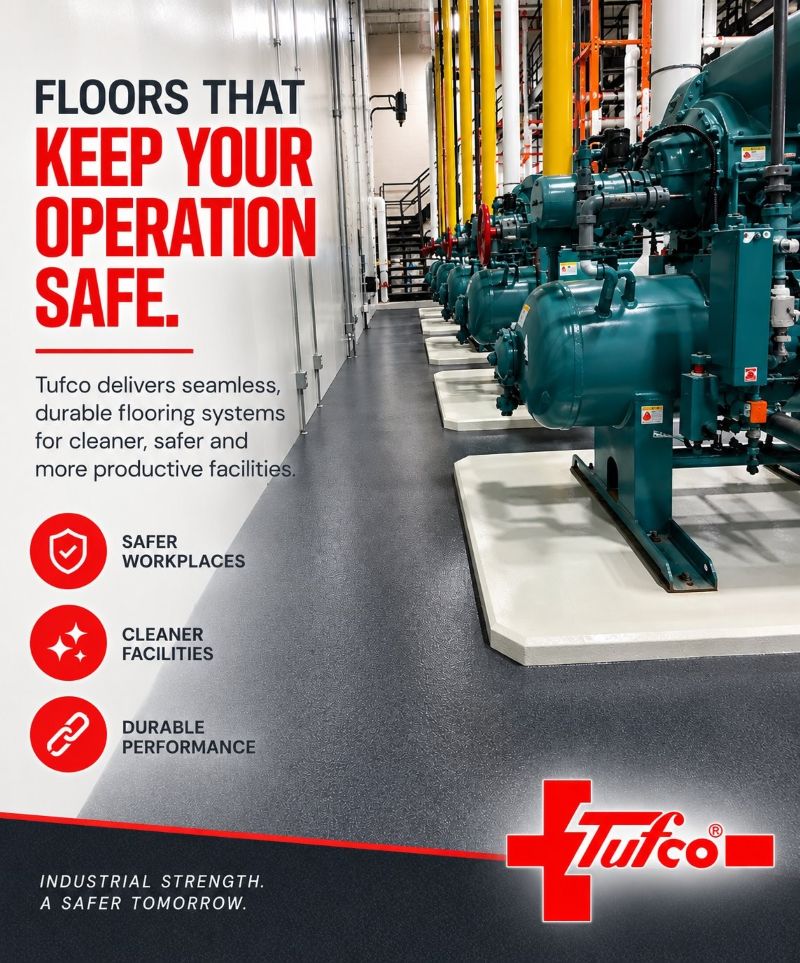
When facility managers assess workplace safety, floors are often among the last things to get serious attention. Equipment guarding, machine lockout procedures, PPE programs, and chemical handling protocols typically dominate safety planning. But the floor beneath every worker, every piece of equipment, and every production line is a constant factor in how safe an industrial facility actually is.
Slips, trips, and falls account for the majority of general industry workplace accidents. According to the U.S. Bureau of Labor Statistics, these incidents resulted in more than 450,000 days away from work in a recent reporting period, and they account for approximately 15% of all accidental workplace deaths according to OSHA. The condition, material, and design of a facility’s floor plays a direct role in those numbers.
Understanding how flooring contributes to workplace hazards is the first step toward making better decisions about how to address them.
Slip-and-Fall Risks: More Than a Wet Floor
The most visible floor-related safety hazard in industrial settings is the slip-and-fall. In manufacturing environments, the contributors go well beyond the occasional spill. Concrete floors, particularly aging ones, develop surface degradation over time. Cracks, pitting, and worn areas create uneven surfaces that increase trip risk. Bare concrete also offers limited traction under wet conditions, and in facilities that involve any kind of washdown, liquid processing, or condensation, wet conditions are frequent rather than occasional.
Food and beverage facilities face a particularly acute version of this challenge. Workers in food processing are 25% more likely to experience a slip or fall than workers in other manufacturing sectors, according to industry safety data. Grease, animal fats, water, and cleaning chemicals create conditions that dramatically reduce traction on standard concrete surfaces.
Flooring systems designed for industrial environments address this directly. Seamless resinous floors, including urethane cement systems and epoxy coatings, can be specified with slip-resistant aggregates and textured finishes that maintain traction even under wet or contaminated conditions. The surface is engineered for the environment rather than adapted from a standard concrete pour.
Chemical Exposure and Floor Degradation
In chemical manufacturing, pharmaceutical production, automotive facilities, and food processing plants, floors are routinely exposed to substances that deteriorate standard concrete over time. Acids, alkalis, solvents, oils, and cleaning agents all work on concrete surfaces in different ways, but the result is similar: spalling, cracking, and surface breakdown that creates both a maintenance problem and a safety hazard.
A degraded floor does more than look worn. Cracks and pits trap liquids and create standing puddles. Uneven surfaces catch foot traffic and equipment wheels. Exposed aggregate and rough patches complicate cleaning. What begins as a chemical resistance problem becomes a slip hazard and a contamination risk at the same time.
High-performance urethane cement and epoxy flooring systems are formulated to resist a broad range of chemical exposures. The right system for a given facility depends on the specific chemicals present, the frequency and concentration of exposure, and whether the environment involves thermal cycling from washdowns or temperature swings. Proper specification from the start prevents the cycle of degradation that leads to hazardous floor conditions.
Contamination Risks in Regulated Environments
In food and beverage, pharmaceutical, and healthcare settings, the floor is not just a walking surface. It is part of the sanitation system. Floors that have cracks, seams, grout lines, or surface voids create locations where bacteria, pathogens, and contaminants can accumulate and resist cleaning.
This is one of the core arguments for seamless flooring in regulated production environments. A truly seamless floor, one installed as a continuous surface without joints or grout lines where contamination can hide, eliminates those accumulation points. Combined with properly sloped drainage systems that move liquids efficiently off the production floor, a seamless flooring system supports the kind of sanitation program that food safety and pharmaceutical compliance standards require.
OSHA’s walking-working surfaces standard (29 CFR 1910.22) requires that floors be kept clean, dry, and free from hazards including leaks and spills. Flooring that is easy to clean, chemically resistant, and drains efficiently supports compliance with that standard rather than working against it.
The Role of Drainage in Floor Safety
Floor drainage is often treated as a separate consideration from the flooring system itself, but the two work together. A floor that pools liquid because of inadequate drainage or improper slope creates a persistent slip hazard regardless of how slip-resistant the surface material is. In facilities with frequent washdowns, drainage design is as important as surface material selection.
Stainless steel drain systems integrated with a resinous flooring installation provide a complete solution. The floor surface channels liquid efficiently to the drain, the drain handles the volume, and the transition between flooring and drain is sealed to prevent infiltration and contamination. When flooring and drainage are designed and installed as a system, the result is more reliable than either component addressed in isolation.
How Tufco Flooring Approaches Industrial Safety
Tufco Flooring has spent more than 50 years providing flooring and drainage solutions for some of the most demanding industrial environments in the country. The company’s client base spans food and beverage processing, chemical manufacturing, pharmaceutical production, healthcare facilities, and automotive operations, sectors where floor performance has direct consequences for safety, compliance, and production continuity.
One of the defining characteristics of Tufco’s approach is that the company both manufactures and installs its flooring systems using its own personnel. That end-to-end control means the material specified is the material installed, and the installation is done by technicians who understand how the product behaves and what it takes to perform over the long term. It also means a single point of accountability and a 5-year warranty backed by the same organization that did the work.
Tufco’s product line includes Tufcrete urethane cement flooring for the most demanding thermal, chemical, and mechanical environments, epoxy systems for a range of industrial applications, and integrated stainless steel drain systems designed to complement the flooring installation.
For facility managers evaluating whether their current floors are working against their safety program, the floor condition, material, slope, drainage, and surface texture are all worth examining. The right flooring system does not just survive the environment. It actively contributes to a safer, cleaner, and more productive facility.
To learn more about Tufco’s industrial flooring and drainage systems, visit tufcoflooring.com or call 800-364-0836.
Sources
https://www.bls.gov/iif/
https://www.osha.gov/laws-regs/regulations/standardnumber/1910/1910.22
https://www.foodmanufacturing.com/safety/article/22525722/reduce-the-chances-of-osha-inspections-due-to-slips-and-falls
