


U.S. trade policy took a dizzying turn this week, with sweeping tariff measures taking center stage, rattling markets and leaving the industrial sector grappling with a volatile mix of optimism and uncertainty. President Trump’s “Liberation Day” announcement introduced a 10% baseline tariff on all imports, effective April 5, 2025, with higher reciprocal tariffs targeting countries with significant trade deficits set to follow on April 9. These measures aim to address trade imbalances and protect domestic industries, but they’ve already sparked global retaliation, with Canada and Mexico imposing counter-tariffs and China escalating its own trade barriers.
But this is not the first time U.S. companies have contended with tariffs. We recently dug into the MNI archives to glean some insight into the impact of tariffs on U.S. manufacturing. What we found was fascinating.
Tariffs, Then & Now
First, Let’s take a step back and explore how tariffs from the 20th century stack up against the sweeping changes we’re seeing today. In the 1920s, the Fordney-McCumber Tariff Act of 1922 pushed tariff rates sky-high, averaging about 38.5% on dutiable goods. It was meant to shield American industries, particularly agriculture, in a post-war economy. While it brought short-term relief for domestic producers, it left European nations—still recovering from the ravages of World War I—grappling with strained trade relations and even retaliatory measures. It was a moment that highlighted how deeply interconnected economies had become.
Fast forward to the 1930s, and the Smoot-Hawley Tariff Act took things even further. Signed into law at the height of the Great Depression, it raised duties to nearly 60% on some 20,000 imported goods. The intention was clear: protect American farmers and manufacturers from foreign competition during a time of economic hardship. But the ripple effects were devastating. Trading partners responded with tariffs of their own, global trade plummeted, and the economic pain deepened.
Today, the Trump administration’s tariffs echo some of these historical measures, but with a modern twist. Instead of focusing solely on goods, these tariffs are aimed at entire trade relationships. A baseline 10% tariff on all imports has been implemented, with additional, country-specific rates targeting nations like China and Vietnam, which have significant trade deficits with the U.S. For context, some of these rates exceed 50%. What’s different today is the focus on rebalancing trade and addressing what are viewed as unfair practices in a globalized economy, compared to the more protectionist objectives of the early 20th century.
The comparison is striking. While the methods and motivations have evolved, the core tension remains: balancing the protection of domestic industries with the complexities of international trade. History shows us that tariffs can bring both relief and retaliation, creating an economic seesaw that affects not only industries but also the broader economy. As manufacturers brace for today’s new policies, there’s much to be learned from the past.
From the MNI Archives: Tariffs in 1930
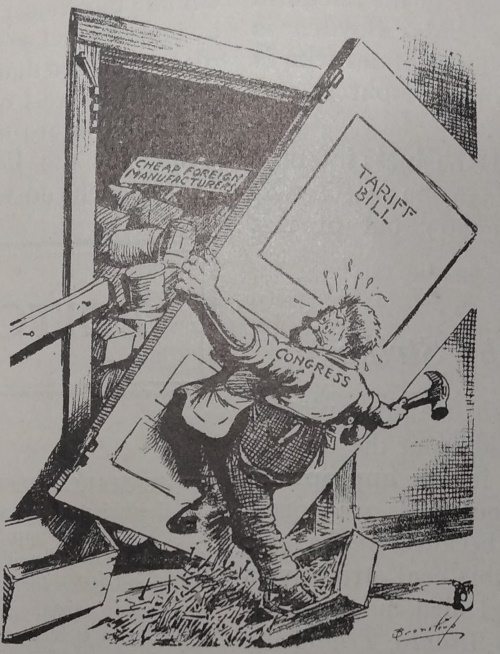
Dating all the way back to the Colonial era, tariffs were fairly common practice throughout U.S. history. Following the Revolutionary War, tariffs were first introduced to the newly formed government in 1789 as a means to fund the federal government (this was prior to the federal income tax). Since then, tariffs have been utilized repeatedly throughout the years, though they have been minimally implemented in the post-World War II era.
Arguably, the most memorable tariff legislation was the Smoot-Hawley Tariff Act of 1930, as it was blamed by many for slowing the economy’s recovery from the Great Depression.
Signed into law by Herbert Hoover, the Smoot-Hawley tariffs were the second largest in U.S. history, with duties imposed on more than 20,000 imported goods. Soon after the legislation was put in place, other trading partners began to respond accordingly, setting their own tariffs in retaliation. A tit-for-tat trade war was set in motion and U.S. trade activity declined by half.
As publishers of industrial information since 1912, we were curious to see what some of our historic issues had to say about tariffs. Sure enough, our issues from 1930 featured all types of fascinating articles on Hoover’s tariffs, including this editorial in July 1930 (Smoot-Hawley was signed into law June of 1930)
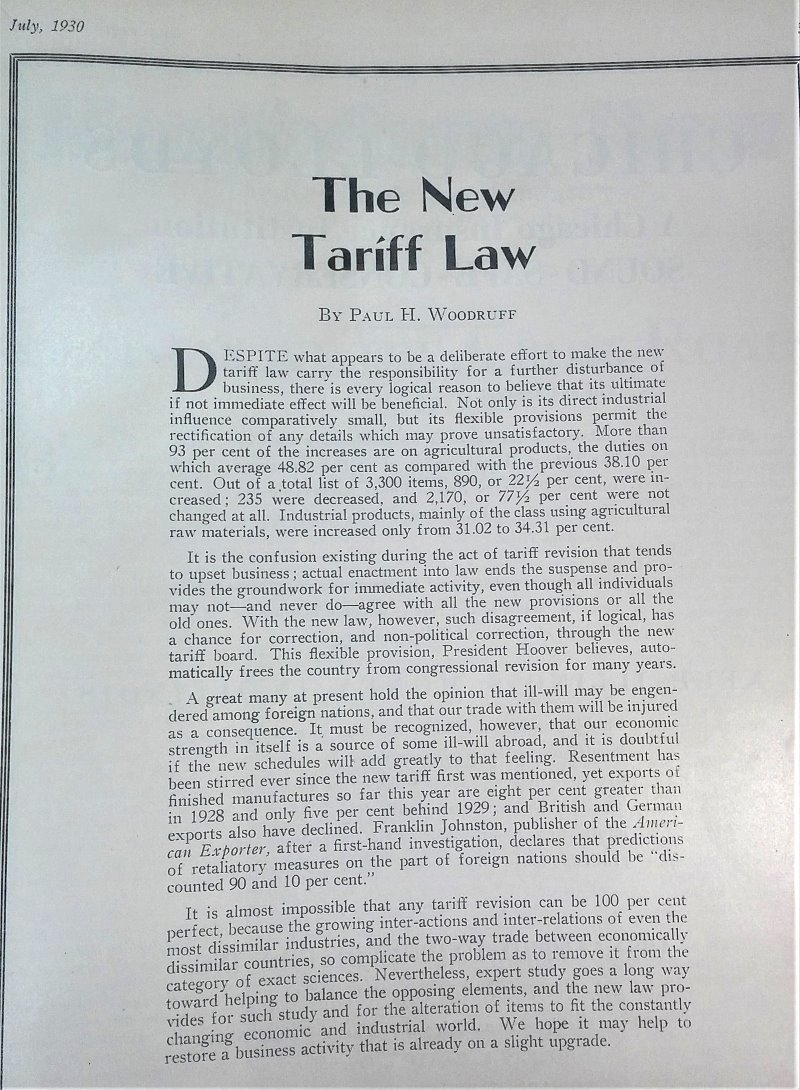
An interesting passage from the editorial states “It is the confusion existing during the act of tariff revision that tends to upset business; actual enactment in to law ends the suspense and provides the groundwork for immediate activity, even though all individuals may not – and never do – agree with all the new provisions or all the old ones.”
Clearly, businesses hated uncertainty in 1930 just as much as they do today.
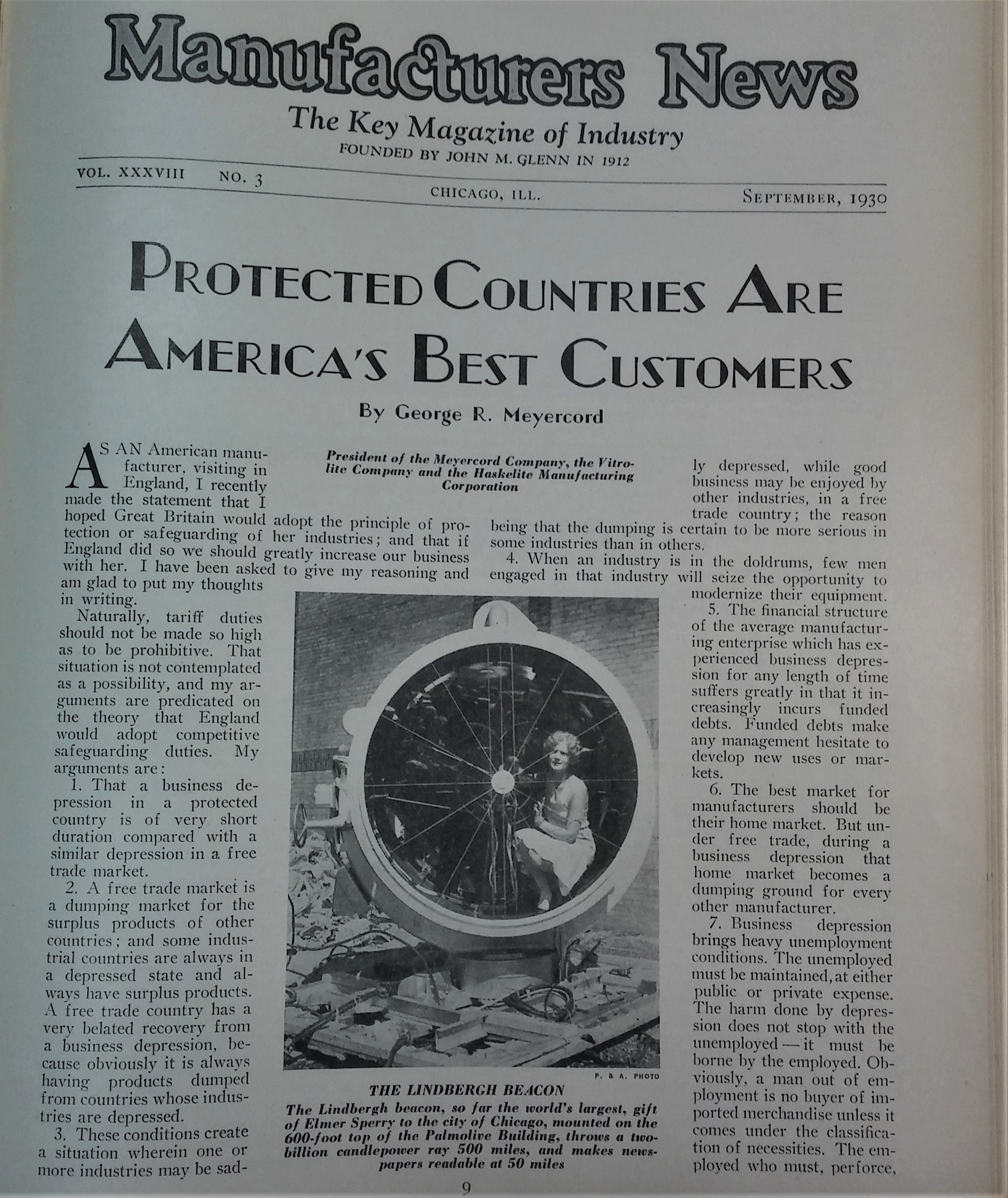
Another article, by George R. Meyercord, president of the Meyercord Company, famous for its “vitrolite” decals and advertising signs, declared: “Protected Countries are America’s Best Customers.”
This article makes a compelling argument for tariffs on the grounds that non-protected nations are subject to more surplus “dumping” from competing countries. Meyercord writes: “The best market for manufacturers should be their home market. But under free trade, during a business depression, that home market becomes a dumping ground for every other manufacturer.”
Interestingly, this statement presages the the intense global competition and U.S. manufacturing job losses that followed the ratification of NAFTA much later in the 20th century.
First on Meyercord’s long list of reasons for supporting tariffs was “That a business depression in a protected country is of very short duration compared with a similar depression in a free trade market.” This is almost painful to read, knowing as we know now, just how long the Great Depression lasted.
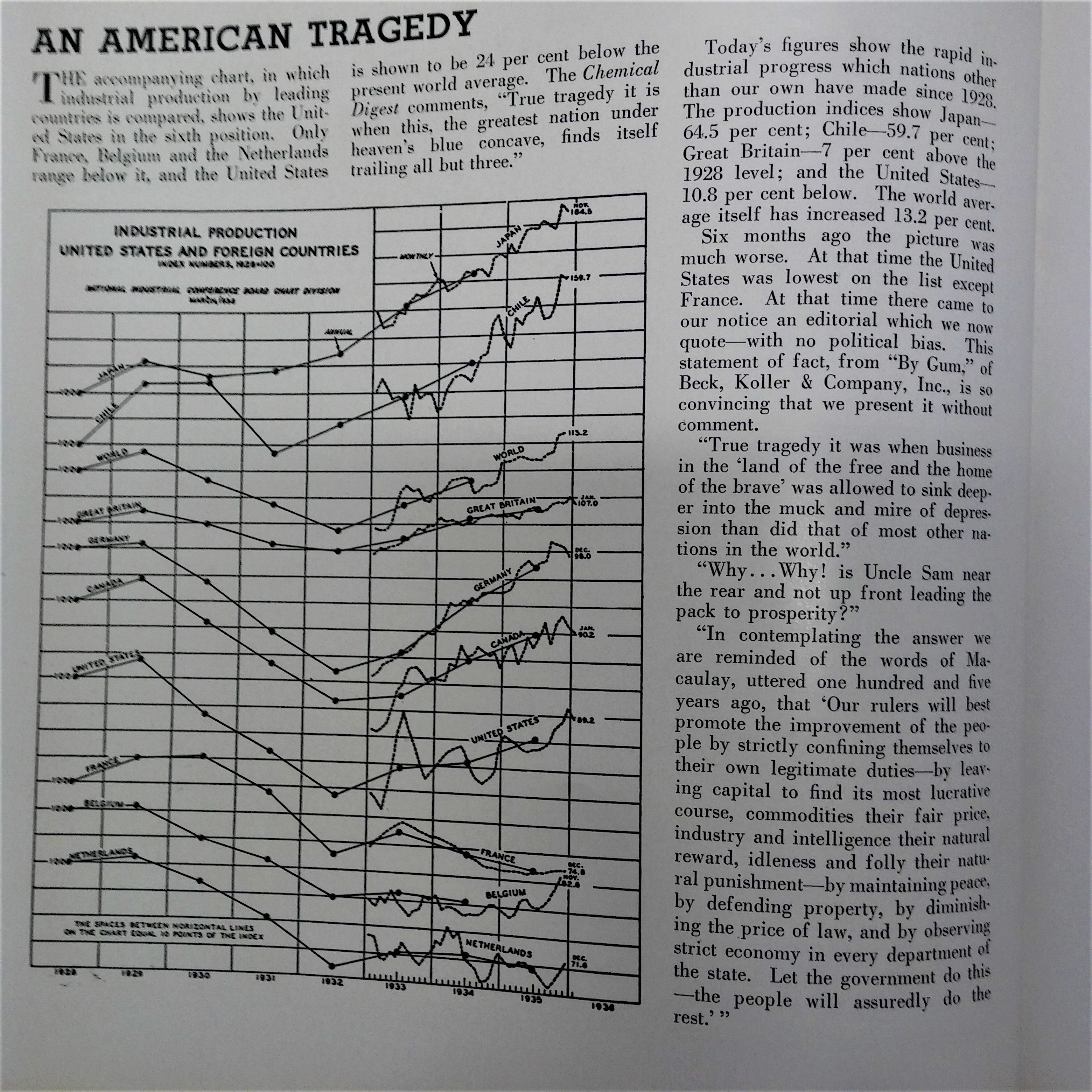
Fast forward to one of our 1936 issues and we came across this article titled “An American Tragedy” which decries the fact that U.S. industrial production had fallen below that of most of the industrialized world. The passage that follows invokes the words of British essayist and vigorous defender of laissez-faire policies, Thomas Macaulay, foreshadowing the embrace of free-market economic policies we saw later in the twentieth century:
“Why…Why! is Uncle Sam near the rear and not up front leading the pack to prosperity? In contemplating the answer we are reminded of the words of Macaulay…'Our rulers will best promote the improvement of the people by strictly confining themselves to their own legitimate duties—by leaving capital to find its most lucrative course, commodities their fair price, industry and intelligence their natural reward, idleness and folly their natural punishment, by maintaining peace, by defending property, by diminishing the price of law, and by observing strict economy in every department of the state. Let the government do this—the people will assuredly do the rest.'”
About MNI Industry Data
As compilers and publishers of U.S. manufacturing data since 1912, MNI has been in close contact with the nation’s manufacturers for more than 100 years, providing comprehensive information on the nation’s industrial sector.
As U.S. manufacturing evolves, MNI continually updates information on 360,000 U.S. manufacturers and suppliers of more than 11,000 products and services, providing vital information for industrial sourcing and purchasing as well as industrial prospecting, sales, and business development. Learn more at https://www.mni.net.
