

In modern manufacturing, reducing assembly time is only part of the challenge. Manufacturers are also looking for ways to reduce part handling, minimize work-in-process inventory, simplify production equipment, and improve process consistency.
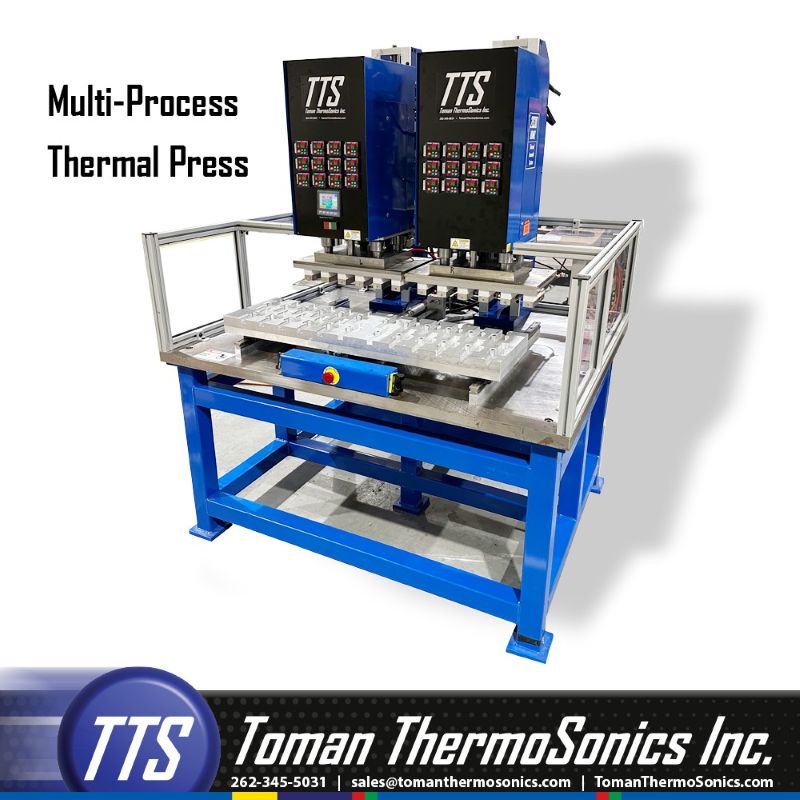
For thermoplastic component assembly, a thermal press can provide an effective solution by performing multiple manufacturing operations within a single machine cycle.
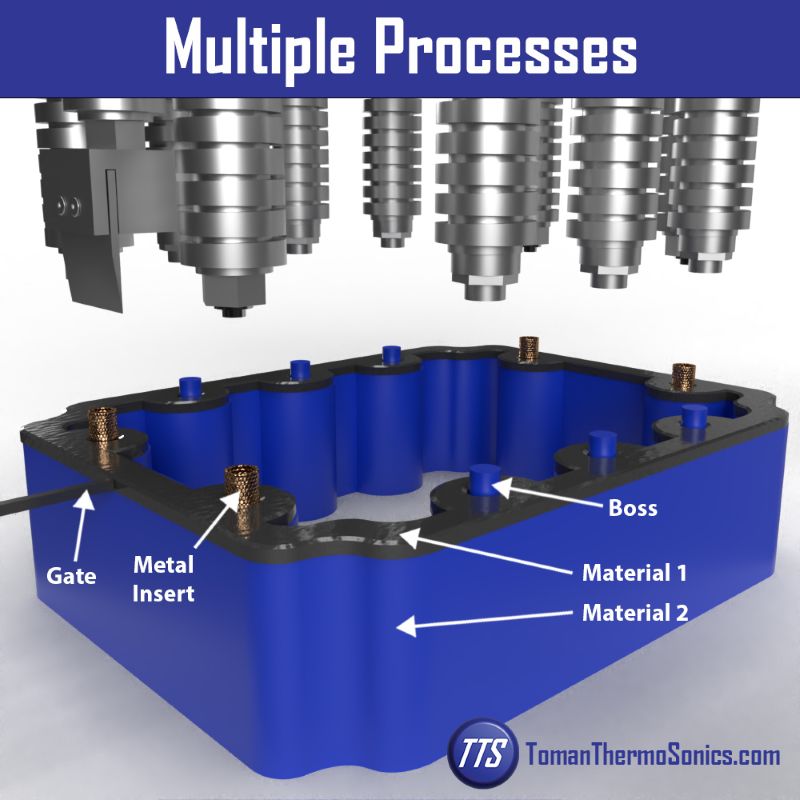
Depending on the part design, tooling configuration, and process requirements, one thermal press can be configured to perform operations such as heat staking, thermal insertion of threaded inserts, de-gating, and heat sealing—potentially eliminating the need for multiple standalone processes.
The result is a more consolidated assembly process with fewer individual manufacturing steps.
One Machine, Multiple Processes
A thermal press is essentially a controlled platform for applying heat, force, and time to a thermoplastic component.
While heat staking is one of its most common applications, the underlying thermal process can be adapted to perform several different operations.
A properly engineered system can incorporate application-specific tooling that allows multiple operations to occur at different locations on the same component.
For example, a single assembly could require:
- Plastic bosses to be heat staked
- Brass or other threaded inserts to be thermally inserted
- Injection-molded gates to be de-gated
- A plastic component to be heat sealed
Instead of moving that component through four separate workstations, a thermal press can potentially perform these operations during one controlled machine cycle.
This approach can significantly simplify the manufacturing process.
Heat Staking
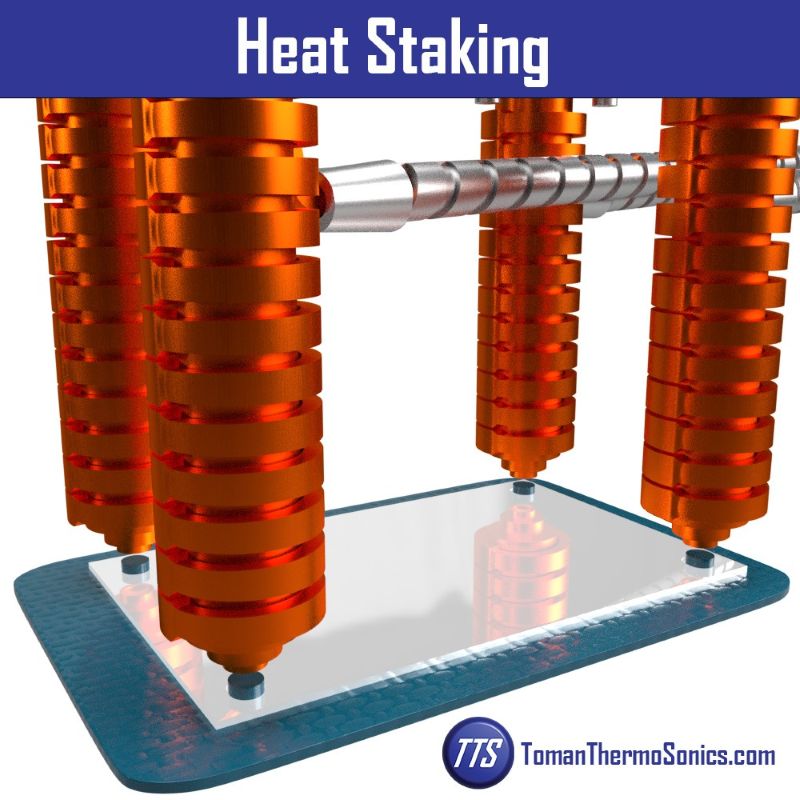
Heat staking joins thermoplastic components by heating and forming molded plastic bosses or posts.
A heated staking tool contacts the plastic boss, bringing the material to a controlled forming temperature. Force is then applied to deform the softened thermoplastic into a predetermined shape. As the material cools, it solidifies and creates a permanent mechanical connection.
Heat staking is particularly useful for securing:
- Electrical components
- Circuit boards
- Sensors
- Switches
- Connectors
- Covers
- Housings
- Brackets
- Interior automotive components
- Appliance components
Multiple bosses can often be staked simultaneously using a custom heat-staking tool.
This allows several attachment points to be completed during one machine cycle rather than individually.
Thermal Insertion of Threaded Inserts
Thermal insertion provides another application for the same basic technology.
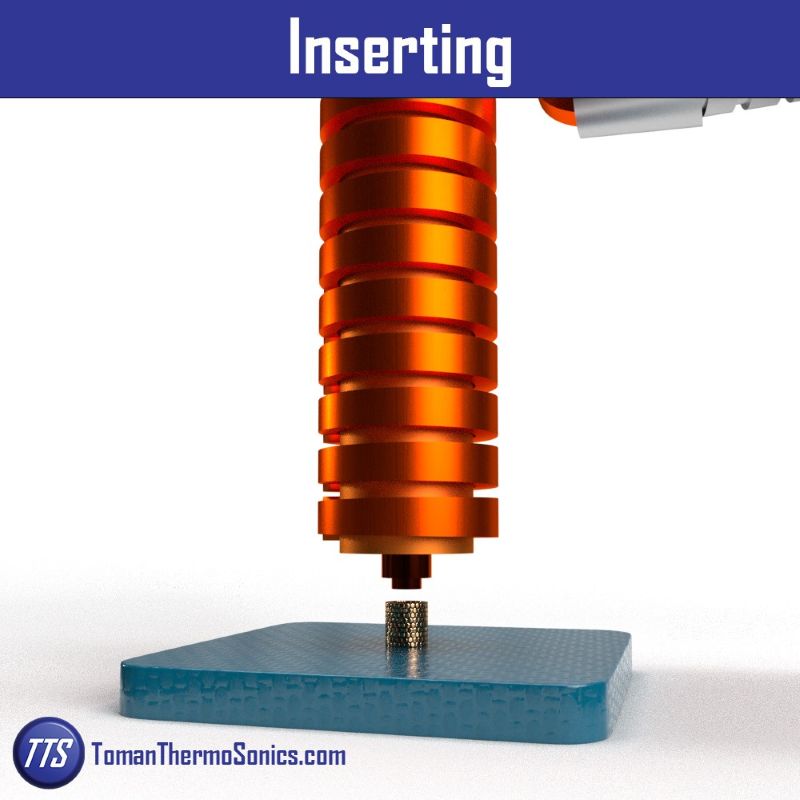
Threaded inserts can be installed into thermoplastic components by heating the insert and/or surrounding plastic and applying controlled insertion force.
As the thermoplastic material softens, the threaded insert is driven into the molded feature. The surrounding plastic then cools around the insert, creating a mechanically retained threaded connection.
This provides a durable threaded mounting point for applications where repeated assembly and disassembly may be required.
Instead of using a separate insertion machine, a thermal press can incorporate an insertion tool alongside other tooling required for the assembly.
De-Gating
De-gating is another operation that can potentially be incorporated into a thermal press.
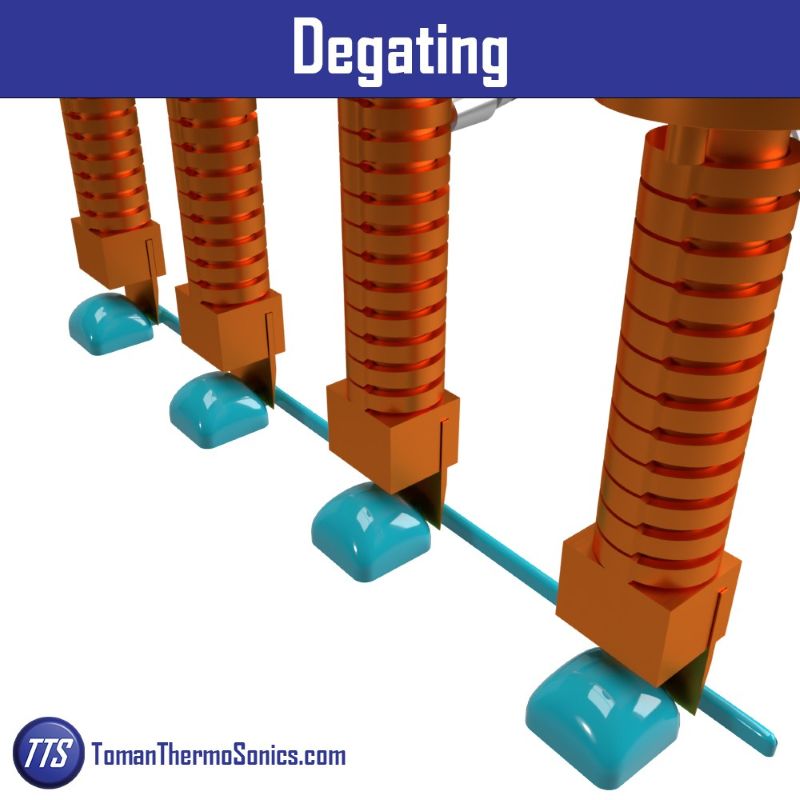
Injection-molded components frequently require removal of gates or other excess plastic left over from the molding process.
Depending on the part geometry and material, a heated tool can be used to soften or sever the gate while simultaneously performing other assembly operations.
Combining de-gating with downstream assembly can eliminate an additional handling and processing step.
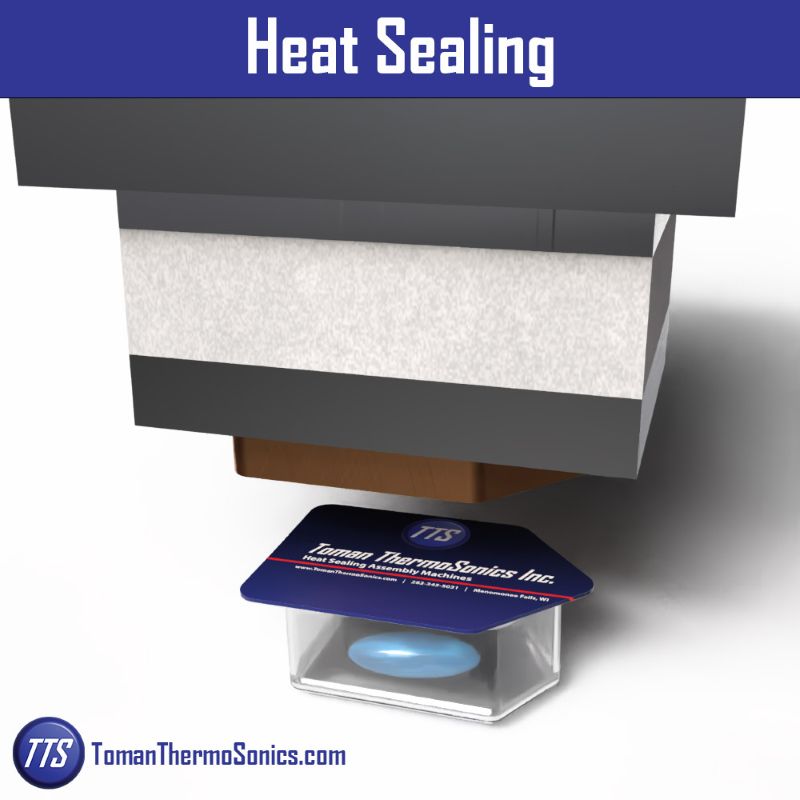
Heat Sealing
Thermal presses can also be configured for heat-sealing applications.
Heat sealing uses controlled temperature and pressure to create a bond or seal between compatible thermoplastic materials.
The process can be engineered around specific requirements for:
- Temperature
- Pressure
- Dwell time
- Cooling time
- Seal geometry
- Material characteristics
For assemblies requiring multiple seals, a custom tool can be designed to perform several sealing locations simultaneously.
This can eliminate multiple individual sealing operations and provide consistent process conditions from part to part.
The Real Advantage: Process Consolidation
The biggest advantage of using one thermal press for multiple operations isn’t simply that the machine can perform several different tasks.
The real advantage is process consolidation.
Every additional manufacturing operation can introduce:
- Part handling
- Labor
- Equipment
- Floor-space requirements
- Setup time
- Work-in-process inventory
- Quality-control requirements
- Opportunities for operator error
When multiple operations can be combined into one machine cycle, many of these variables can be reduced.
Reducing Part Handling
Part handling is often an overlooked contributor to manufacturing cost.
Every time an operator moves a component from one station to another, there is an opportunity for:
- Misalignment
- Damage
- Contamination
- Incorrect orientation
- Lost parts
- Additional labor
- Production delays
A consolidated thermal process can minimize these movements.
The component can be positioned once, and a custom fixture can accurately locate the required features relative to the tooling.
This can improve process repeatability while reducing unnecessary handling.
Improving Assembly Consistency
A thermal press can provide controlled process parameters for each operation.
Temperature, force, dwell time, and cooling time can be established according to the requirements of the application.
This is particularly important when multiple operations are being performed on the same component.
Instead of relying on several independent processes, manufacturers can establish a controlled thermal assembly sequence.
The result can be a more repeatable production process and improved control over critical assembly characteristics.
Custom Tooling Makes the Difference
The versatility of a thermal press comes largely from its tooling.
A machine may provide the heat, force, motion, and controls, but the tooling determines how those capabilities are applied to a specific component.
Custom tooling can incorporate:
- Heat-staking tips
- Thermal insertion tools
- De-gating blades or fixtures
- Heat-sealing surfaces
- Multiple heating zones
- Part-location features
- Replaceable wear components
- Pneumatic or mechanical actuation
This allows the thermal press to be engineered around the actual geometry and requirements of the customer’s assembly.
For complex components, multiple tooling functions can be integrated into a single assembly fixture.
Multiple Heat Zones for Complex Assemblies
Some assemblies contain operations that require different temperatures or thermal profiles.
A thermal press can be configured with multiple independently controlled heat zones when the application requires it.
This allows different areas of the tooling to operate according to their specific process requirements.
For example, one portion of the tooling may be configured for a heat-staking operation while another performs thermal insertion or heat sealing.
The ability to control these processes within the same machine can provide significant flexibility when designing a consolidated assembly process.
Designing the Part Around the Process
The greatest opportunities often occur when the manufacturing process is considered during product development rather than after the part has already been designed.
Engineers can incorporate features specifically intended for thermal assembly, including:
- Heat-staking bosses
- Insert locations
- Sealing surfaces
- De-gating locations
- Proper material thickness
- Tool-access areas
- Controlled part-location features
Designing these features into the component from the beginning can make it much easier to consolidate multiple assembly operations.
In many cases, the question isn’t whether an existing assembly process can be combined. It is whether the product can be designed to take advantage of a consolidated thermal process.
Contact Toman ThermoSonics Inc. to learn more about Thermal Press Machines.
Website: https://www.tomanthermosonics.com/
Email: sales@tomanthermosonics.com
Phone: 262-345-5031
Mail:
W158 N9305 Nor-X-Way Ave
Menomonee Falls, WI 53051
