

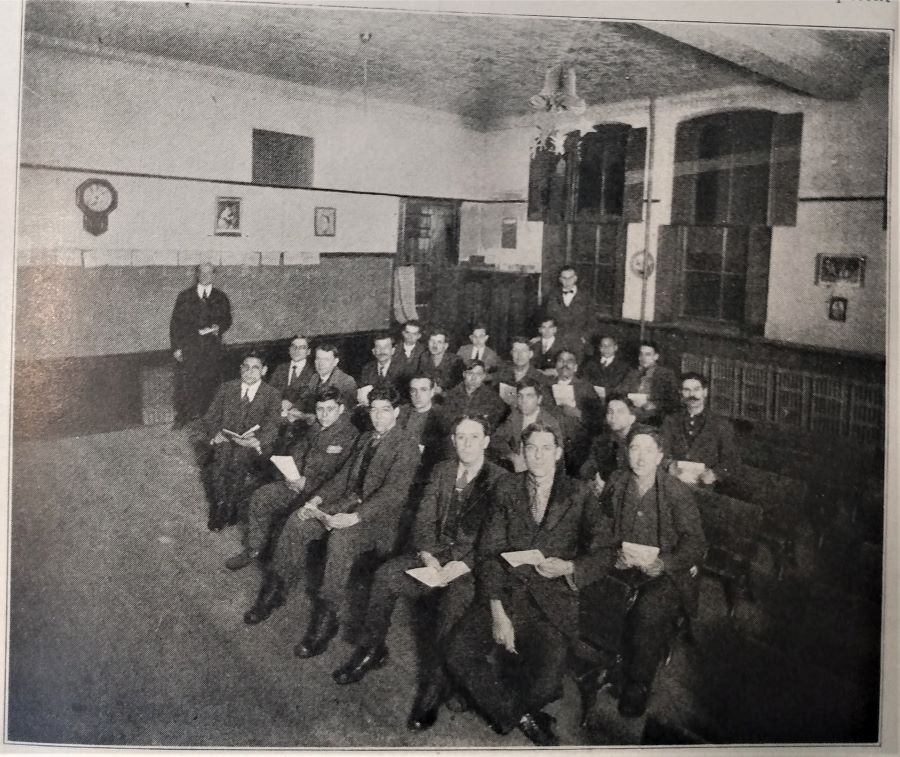
Above: A Business English class at Ohio-based American Steel & Wire in 1922 (Source: April 6th, 1922 edition of Manufacturers' News)
Manufacturing is one of the most vital sectors of the U.S. economy, but it also faces some of the most daunting challenges in terms of workforce development. The skills gap, the shortage of qualified workers with the right technical and soft skills, has been a persistent problem for manufacturers for decades. The COVID-19 pandemic has only exacerbated this issue, as many workers have left the industry or retired, leaving behind a knowledge gap and a talent pipeline crisis. How can manufacturers overcome these challenges and prepare their workforce for the future?
One possible solution is to look back at the past and learn from the successful examples of industrial education that were implemented by some of the leading manufacturers in the early 20th century. In this article, we will explore how American Steel & Wire Company, a subsidiary of U.S. Steel, created a comprehensive and innovative educational program for its workers that spanned all aspects of its business, from sales to production to administration.
A Trailblazing Approach to Workforce Development
Amid the great industrial upheaval of the late 19th and early 20th centuries, the United States witnessed an unprecedented surge in urban industrial growth. This transformative era saw employment in manufacturing skyrocket from a modest 2.5 million workers in 1880 to a staggering ten million by 1920. Yet, this explosive expansion was not without its challenges, especially in the realm of education and training for the burgeoning workforce.
The historical landscape was marked by a scarcity of accessible educational resources for the new generations of workers entering the manufacturing sector. In response, it fell upon the shoulders of manufacturers themselves to undertake the formidable task of equipping and educating their workforce to keep pace with the soaring demands of the industrial landscape.
An example of the historic push to successfully train and employ this surge in workers appeared in a story published 100 years ago in the April 6th, 1922 edition of Manufacturers’ News. The article, titled “Industrial Education Inspiring to Workers,” tells the story of how American Steel & Wire Company leveraged in-house educational resources to foster a more productive and fulfilled workforce, providing a broad-based educational program that spanned all aspects of the company’s key roles, from sales to administration to production workers.
Cleveland, Ohio-based American Steel & Wire Company, at the time a subsidiary of U.S. Steel, reported 20,000 immigrant workers at its mills across the United States who spoke 82 different languages and dialects, spurring the need to take an innovative approach to ensure its workers were well-rounded and prepared for the demands of factory work.
The article, authored by Charles R. Sturdevant, at the time the Educational Director for American Steel & Wire Company, described the wide range of courses the company provided for its workers, including intensive courses for its salesmen, a special business English course for general office workers, “Americanization” courses for non-English speaking employees, “vestibule” schools for skilled and unskilled workers, a trades course for their craftsmen, a special apprentice course for a limited number of technically trained workers, and a course for foremen and supervisors.
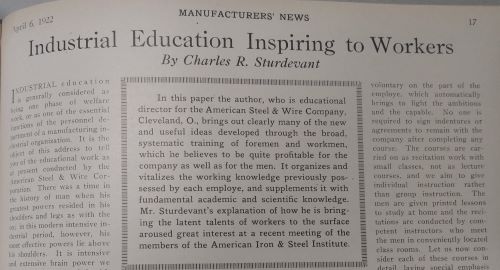
Interestingly, the classes were all voluntary, which “automatically [brought] to light the ambitious and the capable.” This no-strings-attached approach turned out to an effective one.
“Once convinced that the company has no ax to grind and no sinister motives,” wrote Sturdevant, “Our men have not only responded to the opportunities offered in a most encouraging manner, but they are seeking admittance to the various courses offers, and once admitted they go to work with a will that has been most surprising and gratifying.”
The education provided by American Steel & Wire was intensive and comprehensive, going beyond the bounds of pure apprenticeship. Sales students, for instance, spent six consecutive weeks studying the materials and processes of all the company’s products so that they could better sell it. The classes for foremen and supervisors consisted of 175 separate lessons over a two-and-a half year period, covering all activities related to supervising steel and wire mills, as well as instruction in physics and chemistry.
The company even went so far as to support its workers' personal passions. “We have been offering our musically inclined employees much help and encouragement through the development of several different musical organizations,” Sturdevant writes, “There are now at our various works about 25 brass bands and a number of orchestras, glee clubs, quartets, and so on.”
Sturdevant concludes that the company’s educational program “Greatly helped our foremen to strengthen and build up their own department” and “discovered and developed much talent in the organization.”
Learning from the Past to Address Today's Workforce Challenges
The manufacturing landscape today introduces additional complexities, from a widening skills gap to an increasingly competitive global market. Meanwhile, the challenge of finding and retaining qualified workers capable of mastering advanced technologies has become more pronounced than ever. As the Fourth Industrial Revolution takes hold, incorporating automation, artificial intelligence, and data analytics into the manufacturing process, manufacturers are tasked with recruiting individuals who possess not only technical proficiency but also adaptability and digital literacy.
The echoes of the past remind us that, just as American Steel & Wire Company tailored its educational programs to the diverse needs of its workforce, today's manufacturers must also embrace a versatile approach. Integrating apprenticeships, targeted technical training, and continuous upskilling programs will be essential in bridging the skills gap and ensuring that the workforce remains aligned with the evolving demands of the manufacturing sector.
By intertwining historical wisdom with contemporary strategies, we can forge a path toward a thriving manufacturing sector that not only mirrors the past successes but also propels us into a future rich with possibilities.
About MNI
As compilers and publishers of U.S. manufacturing data since 1912, MNI (Manufacturers’ News, Inc.) has been in close contact with the nation’s manufacturers for 111 years, providing comprehensive information on the nation’s industrial sector for sales, marketing, purchasing and procurement.
Looking for comprehensive information on U.S. manufacturers? See all of our industrial solutions.
Read more from the archives!
How This Small Illinois Manufacturer Made 2.5 Million Gloves in 48 Hours for WWI Troops
What Manufacturers Were Saying About Tariffs in 1930
From the MNI Archives: The Humble Beginnings of a Powerful American Steel Company
Sources: Immigration and the American Industrial Revolution From 1880 to 1920
https://www.ncbi.nlm.nih.gov/pmc/articles/PMC2760060/
Editor's note: this article was originally published in August 2022.
