

Manufacturing's labor shortage gets most of the headlines, but a quieter problem is building inside plants that are already fully staffed. The people who know how things actually get done are getting older, and much of what they know has never been written down anywhere.
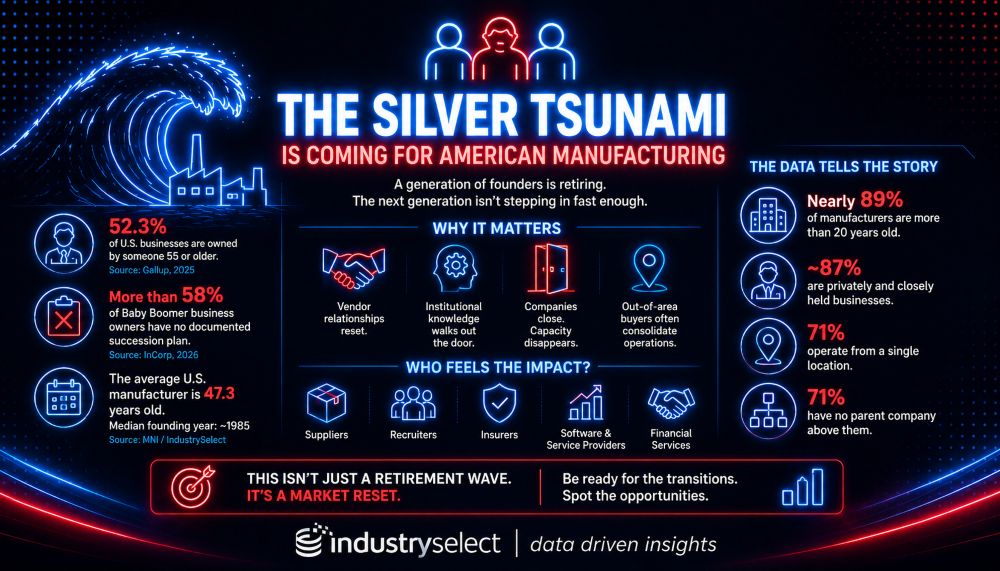
The average age of highly skilled manufacturing employees is 56, and close to a third of manufacturing professionals are over 50, according to industry research covered by ACHR News, while the latest McKinsey research finds the share of manufacturing workers over 55 has more than doubled in the past twenty years. A separate look at MNI's own database of U.S. manufacturers found that the typical manufacturer is decades old, privately held, and operating from a single location, old enough that a leadership transition may be close at hand whether or not one has already happened. That piece, The Silver Tsunami Is Coming for American Manufacturing, is worth reading if you want the full picture of what an aging ownership base means for the industry.
This one is about a related but different problem. Even in shops where nobody is planning to sell, the people who scaled the business are heading for the door on their own timeline.
How Old Is the Manufacturing Workforce
The numbers back up what most plant managers already sense on the floor. A Manufacturing Institute study, The Aging of the Manufacturing Workforce, found that 97 percent of manufacturing firms are aware their workforce is aging, and 78 percent say they are very or somewhat concerned about it. The same study found that 97 percent of firms express at least some concern about brain drain specifically, meaning the loss of institutional and technical knowledge, with nearly half saying they are very concerned about it.
Retirement, rather than resignation, is driving most of the churn. A Manufacturing Institute survey of 3,000 Americans, reported by the National Association of Manufacturers, found that 82 percent of people who had left a manufacturing job in the prior six months did so because they were retiring due to age or health, not because they quit for another opportunity.
Two Different Clocks Are Running
It helps to separate two things that tend to get lumped together under "aging workforce." One is ownership: who runs the company, and whether there is a plan for what happens when they step back. The other is floor-level expertise: the senior machinists, maintenance technicians, and engineers who know the equipment, the customers, and the workarounds that keep production moving.
IndustrySelect's research draws this distinction clearly, describing an ownership exit candidate profile (an aging, closely held company where a sale or handoff may be approaching) separately from a workforce knowledge gap profile, where the owner may have no plans to leave but the people who built the operation's capabilities are retiring anyway. Many manufacturers are dealing with both clocks running at once. Some are only dealing with one. Either way, the workforce clock does not wait for the ownership question to get resolved first.
What Actually Gets Lost
The knowledge that leaves with a retiring employee rarely shows up in a manual. It is the machinist who knows how to adjust a tool by feel to compensate for a bad batch of material. It is the technician who can diagnose a failing motor by the sound it makes before it fails. It is the line supervisor who can predict a bottleneck two shifts before it shows up on a report.
None of that is exotic or unusual. It is simply the accumulated judgment that comes from years on a specific floor with specific equipment, and it does not transfer through a job posting or an onboarding packet.
Why So Few Companies Have a Plan
Awareness of the problem is high. Planning for it is not. A 2025 survey of manufacturers in northeast Wisconsin, the Northeast Wisconsin Manufacturing Alliance's 2025 Aging Workforce Study, found that 75 percent of respondents were concerned about their workforce retiring, but only 37 percent had an actual plan in place to address it. That gap between concern and action shows up nationally too. The same Manufacturing Institute research that found 78 percent of firms concerned about the aging workforce also points to a large share of firms that have not moved from awareness to a documented response.
Part of the problem is timing. Production deadlines are immediate. Knowledge documentation is not. When the two compete for a supervisor's attention, the deadline usually wins, and the documentation gets pushed to a quarter that never arrives.
What Manufacturers Can Do Now
The fix does not require new software or a formal program with a name. It requires treating knowledge capture as a scheduled task rather than something that happens if there is time left over.
Pairing a retiring employee with their eventual replacement months before the retirement date, not weeks, gives both people time for the transfer to actually happen. Some manufacturers create a short transition role for employees approaching retirement, six to twelve months focused specifically on documenting processes and training a successor, rather than expecting that work to happen alongside a full production schedule. Video, not just written procedures, captures things a document cannot, like the sound a machine makes right before it needs maintenance or the exact hand position for a difficult weld. Cross-training more than one person on a critical process also means a single retirement does not become a single point of failure.
None of this eliminates the need to hire. But it buys time, and it means new hires are learning from documented knowledge instead of reinventing it from scratch.
Outside Resources Worth Tapping
Manufacturers do not have to build all of this from scratch. Federal policy shifted toward apprenticeships in April 2025, when an executive order directed the Departments of Labor, Education, and Commerce to align workforce programs with reindustrialization needs and set a goal of supporting more than a million apprenticeships a year. To explore further, read our post New Trump Plan Targets Skilled Labor Shortage, which covers what that means for manufacturers weighing whether to formalize an apprenticeship track.
On the funding side, the SBA's Empower to Grow program, formerly known as the 7(j) Management and Technical Assistance program, offers eligible manufacturers free training and consulting on operations, hiring, and workforce development. In 2026 the SBA also awarded $50 million through its Manufacturing in America E2G Grant Initiative to organizations, many of them community colleges, that deliver hands-on manufacturing training. Maine's community college system, for example, used its award to expand machining, welding, and blueprint reading classes across three campuses, according to Community College Daily. Manufacturers in other states can look for similar E2G-funded programs nearby, or encourage a local community college to apply for the next funding round.
The Manufacturing Institute's FAME program is another established option worth knowing about. It trains multi-skilled maintenance technicians through a public-private model that manufacturers can join rather than build in-house.
None of these programs solve the knowledge-transfer problem on their own. They build the pipeline of new workers who will eventually need that knowledge passed down to them, which makes them a natural complement to the internal steps above rather than a replacement for them. To explore further, read our post Creative Recruitment Strategies for Manufacturers, which covers additional tactics for attracting talent beyond the retirement side of the equation.
When the Two Clocks Overlap
In smaller, founder-led shops, the two clocks described above often run together. The owner nearing retirement may also be the person who remembers why a process is done a certain way, information that has never been written down because the owner has simply always known it. Manufacturers thinking about their own ownership transition, not just their workforce, will find more on that side of the picture in IndustrySelect's Silver Tsunami post.
The Case for Starting Now
The manufacturing workforce is not going to get younger, and the pace of retirement is not going to slow down on its own. The shops that come out ahead will be the ones that treated knowledge transfer as routine business planning well before a retirement notice forced the issue. The ones that wait will be relearning lessons their own retired employees had already solved years earlier.
