

Choosing the right metal for your application is crucial to ensuring a finished product that is not only able to serve its intended purpose but that also meets all safety specifications. Titanium is a popular transitional metal that is used in the manufacturing of many applications across a variety of industries due to its favorable properties: it has the strength of steel at half the weight and is twice as strong as aluminum at only a little over 50% of the weight. These characteristics along with superior corrosion-resistance make titanium a highly desirable component for the creation of a countless number of products. This manufacturing overview covers the metal’s history, types, properties and uses.
The Basics and Background of Titanium
Titanium is a common element that is found in the Earth's crust. Its atomic number is 22 on the periodic table of elements. The two primary minerals which contain titanium, are Rutile and ilmenite which make up 24% of the earth’s crust. This leads to Titanium being the 9th most abundant Earth metal and is typically found in rocks and sediments.
Being a transition metal, Titanium can bond using electrons from multiple energy levels. The metal is silver in color, of low density, and high strength. Titanium alloys have excellent heat transfer properties, a high melting point, a high degree of resistance to minerals, acids, and chlorides, a high degree of electrical resistance, and are non-toxic.
The inception of Titanium dates back to 1791, unknowingly first discovered by geologist Rev. William Gregor. Four years later, it was officially named ‘titanium’ by German scientist Martin Heinrich Klaproth. The name originates from the word 'Titan' which comes from the Greek Mythology beings known as 'Titans', which were extremely strong and resilient. A little over a century later in 1910, Matthew A. Hunter, an American metallurgist, was the first to produce pure titanium. Then in 1932, William Justin Kroll was the first to produce titanium metal outside of the laboratory by reducing titanium tetrachloride (TiCl4) with calcium, later refining this process with magnesium and sodium.
The Production Process of Titanium
In nature, Titanium only occurs in chemical combinations; the most common of which are oxygen and iron. In order to reach a finished product, titanium must go through several different processes to reach a finished product. The number and type of processes vary depending on the intended final application. However, no matter what the desired product is, titanium must first be separated out from the ore and turned into pure titanium. This is called the Kroll Process.
The Kroll Process begins with the ore starting off in a fluidized bed reactor which produces purified titanium oxide. The purified titanium oxide is then oxidized with chlorine to produce titanium tetrachloride. The impurities are then fractionally distilled, and the product is then moved into a stainless steel reactor where it is mixed with magnesium in an atmosphere of argon. Titanium 3 and titanium 2 chlorides (TiCl2) are the results of this step and they are then reduced to produce pure titanium and magnesium chloride. This process takes several days to complete and results in a titanium "titanium sponge”. Once sponge has been produced, the process continues with the melting of titanium sponge, or sponge plus the master alloy. This is done to form an ingot. From there the material moves to primary fabrication where an ingot is converted into general mill products such as billet, bar, plate, sheet, strip, and tube, and then secondary fabrication of finished shapes from mill products.

The Characteristics of Titanium
Titanium is a strong and light material with other unique properties that make it highly sought after in the production of many modern and innovative applications. Its tensile strength is between 30,000 psi to 200,000 psi depending on the type of titanium. It is also low density; about 60% the density of iron, reducing load and strain of heavier metals while reducing the overall weight of the objects it is used to manufacture. Titanium has the highest strength-to-density ratio of any metallic element. Titanium is extremely desirable in medical manufacturing because it is one of the most biocompatible metals that exist, leading to its use in everything from artificial joints to cardiac valves and other surgical implantable devices.
Its melting point is much higher than Stainless Steel and its thermal expansion rates are generally equivalent to approximately 50% of stainless steel. This means that there is less dimensional change induced by heating titanium when compared to Stainless or Aluminum. This along with its superconductive properties lends well to use in devices such as induction motors and semiconductor manufacturing.
However, there are a few concerning characteristics to be mindful of when it comes to this metal. Since it is so strong, titanium can be difficult to cast. It also has high reactivity, which means it must be closely managed during every phase of manufacturing. Compared to other metals, titanium tends to be more expensive because of its valuable properties and the time and resources it takes to produce it.
The Types and Typical Uses of Titanium
There are various types of titanium that are suitable for different applications based on their strengths and properties. For a better understanding of the differences between Titanium Alloys and Commercially Pure Titanium, continue learning here. A brief summary of each type is listed below:
Titanium Dioxide – Also known as titanium oxide, Ti dioxide comes in a fine white titanium powder which gives products a bright white hue. It is created when titanium naturally interacts with oxygen. This form of titanium is extremely popular in everyday products such as paper, plastics, sunscreen, toothpaste, cosmetics, paints, and even adhesives.
Titanium Alloys (Alpha, Beta, Alpha-Beta): Alpha-Beta titanium is the combination of two or more metals. The outcome results in a product that is stronger than any of the parent elements. It is important to note that Alpha-Beta titanium alloys co-exist and have the ability to be further processed to give an even more diverse set of properties that make this metal ideal for an array of applications across numerous industries. Alpha-Beta Titanium often contains alloying elements such as Aluminum or Vanadium and these lead to great corrosion resistance and use at high temperatures.
Grade 5 Titanium – This alloy has dominated the titanium for decades discussion when it comes to manufacturing applications, mainly due to the extensive use of this workhorse alloy for military and advanced aerospace applications. While Grade 5 is very strong, its low formability can make it somewhat hard to work with.
Ti Grade 9 (Titanium 3-2.5) - This contains 3% Aluminum and 2.5% Vanadium, it has great corrosion resistance and can be used extensively in aerospace, chemical processing, medical, marine, automotive. Grade 9 can be rolled down into much smaller gauges, making it versatile for a wide range of parts and components. It has excellent corrosion resistance and can be used at higher temperatures than Commercially Pure Grades.
For a deeper comparison between Grade 5 and Grade 9 Titanium, continuing reading this article.
Titanium Beta 21S - This alloy is one of the beta titanium alloys which was developed as an oxidation-resistant aerospace material and as a matrix for metal-matrix composite
Titanium 15-3-3-3 - This alloy is a metastable beta titanium alloy that offers substantial weight reductions over other engineering materials if used in the solution treated condition. It has excellent cold formability.
Titanium Grade 1 - This is the softest form of pure titanium with a high degree of weldability and high ductility. It is most commonly used in the architecture, medical, and marine industries. Grade 1 has the lowest oxygen (O) % allowance of any of the commercially pure grades. With each increase in grade comes an increased oxygen allowance.
Titanium Grade 2 - This variation features moderate strength and a high degree of malleability. It is oxidation and corrosion resistant. Grade 2 is most commonly used in architecture, automotive parts, aerospace, and desalination.
Titanium Grade 3 – Grade 3 Ti is a pure titanium that is stronger than the grades above it, but also less malleable as well. It is popular in hydrocarbon processing, aerospace, and marine industries.
Titanium Grade 4 – This alloy is stronger than grades 2 and 3. It also has a lower ductility, but very high corrosion resistance properties. It used in applications where a high degree of strength is a must including the medical industry and the aerospace industry. Grade 4 has the highest oxygen (O) % allowance of any of the commercially pure grades.
The History of Titanium Re-Rolling at Ulbrich
During the Cold War in the 1950’s and 60’s, titanium was considered a strategic material used in aerospace and defense applications by both the United Sates government and the Soviet Union.
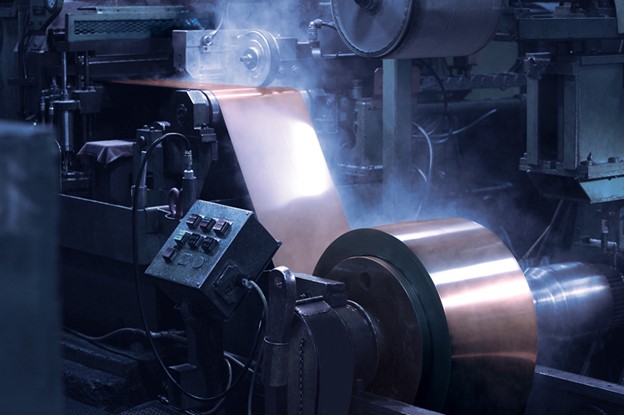
The key point of entry into titanium, for Ulbrich, occurred in the late 1980's with their first established customer program for continuous Grade 9 titanium strip. The company supplied titanium metal to the aerospace market and many subcontractors involved in developing and producing commercial and military airframes. The aerospace market had a growing need for titanium coiled strip and foil for the structural components fabricated to protect these airframes' engine components. As a result of the dedication of their in-house metallurgists, Ulbrich developed a supply chain to purchase small rolls of titanium starting material, then cold rolled the metal inside their facility. This proved to be a challenge, as Titanium behaves very differently than stainless steel and nickel alloys.
Ulbrich’s production quickly adapted to the difficulty of producing titanium, developing new techniques and investing in new capabilities to deliver titanium metal product that met both the company and their customer's expectations. Many capabilities in both the rolling process and annealing process were made possible through the development of technology and installation of new equipment. Ulbrich’s accomplishments in the titanium industry helped build confidence within the company, which led to even further developments to help establish Ulbrich as a key partner for titanium strip across multiple industries. Over time, Ulbrich refined their process and positioned themselves to take on the next generation of titanium demands.
About Ulbrich
Ulbrich Stainless Steels & Special Metals, Inc., is a fourth-generation family owned and operated business with 11 locations in five countries across North America, Asia and Europe. As a precision re-roller and distributor of stainless steels and special metals, Ulbrich is a capability-driven company, offering a wide range of products and solutions across multiple industries such as medical, automotive, aerospace, electronics, power generation, industrial, oil & gas, consumer, and solar. With nearly a century of experience, the company has the knowledge and capabilities necessary to fulfill the material requirements for your demanding applications. Ulbrich specializes in precision metals across a variety of industries. No matter what your application requirements are, their expertise combined with state-of-the-art methods ensures that the finished product will not only meet but exceed your needs. Contact Ulbrich today and let their product development team help you with your next project!
Learn more at www.ulbrich.com.
Have industry knowledge like this to share? Learn more about IndustryNet's marketing services.
