

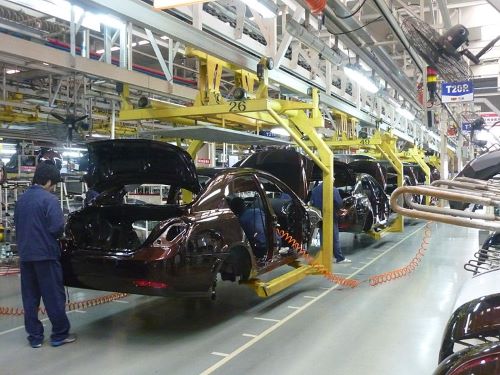
As demand continues to soar, U.S. manufacturers are plowing through enormous challenges to get their products to market. So what are the latest trends and how optimistic are manufacturers about future business conditions? Today, we’re delivering essential summaries from the month’s most critical manufacturing reports, exploring executive optimism, output, labor, regional trends and a special survey on supply disruptions.
Executive Summary
• The semiconductor shortage in the auto industry continued to impact labor and output readings in June.
• The sector saw little change in manufacturing output in June as severe losses in motor vehicle production erased gains in metals, aerospace, and non-durables.
• Manufacturing is still plagued by a worker shortage, with job openings at a record high.
• Manufacturing activity reached its 13th straight month of expansion. Executive optimism, though more muted than last month, remains exceptionally high. Prices hit a record high.
• Companies note struggles with meeting demand, high prices, supply shortages and lack of skilled workers.
• Regional surveys point to expanded manufacturing activity across the board.
Manufacturing Output on the Rise
U.S. industrial output advanced another 0.4% in June, following a 0.7% uptick in May, according to the latest report from the Federal Reserve.
Taken alone, however, manufacturing output declined 0.1% in June, due to a sharp decline in motor vehicle production. Mining output rose 1.4%, while utilities climbed 2.7%.
Looking at the second quarter as a whole, industrial output rose 5.5%, while manufacturing output rose 3.7%. Looking at year-over-year data, industrial production climbed 9.8% from June 2020, but still remains 1.2% below the pre-pandemic level.
Meanwhile, capacity utilization in manufacturing fell 0.1% in June to a level of 75.6%.
Taking a closer look at the Fed’s manufacturing data, output gains in the non-durable goods sector were outstripped by losses in durable goods.
The 0.2% loss in durable goods output was led by the motor vehicle industry. After seeing a surge of 6.7% in motor vehicle output in May, the industry suffered a 6.6% loss in production, likely fueled by an ongoing semiconductor shortage that continues to impact the industry.
Meanwhile, electrical equipment and components posted a 2.2% loss, while non-metallic mineral products edged down 1.1% and wood products declined 0.2%.
Most other durable goods industries posted gains, including primary metals, up 4%; aerospace and miscellaneous transportation equipment, up 3.7% and miscellaneous durable goods manufacturing, up 1.2%.
On the non-durable goods side, gains were led by printing and related support activity, which saw a 1.7% increase and petroleum products, up 1.4%. Chemicals and plastic/rubber products each saw a 0.6% increase.
Hiring in Manufacturing Slows in June, Even as Unfilled Positions Rise
Manufacturers hired at roughly the same rate in June as in May, but not at rate fast enough to fill the record number of unfilled jobs in the sector. According to the Labor Department’s most recent report, manufacturers added 15,000 jobs in June, slightly behind the 22,000 jobs added in May, and a far cry from the 854,000 positions currently unfilled in the manufacturing sector.
June’s manufacturing job gains were spread across multiple industries and were strongest in durable goods manufacturing, which added 18,000 jobs. Furniture manufacturing added the most jobs, up by 8,500, while fabricated metals products added 5,700. Primary metals, wood products and electrical equipment also posted strong gains.
Losses were led by the motor vehicles and parts industries, with that sector down by 12,300 jobs.
Non-durable goods manufacturing declined by 3,000 jobs. Food manufacturing declined the most, down 4,100, while plastics and rubber products declined 2,900 and printing fell 1,400. Gains were seen in chemicals (+1,700); paper products (+1,500); and textile mills (+900).
Manufacturing Activity Continues Expansion
Meanwhile, the Institute for Supply Management reported that the U.S. manufacturing sector reached its thirteenth straight month of expansion in June, even as industrial companies faced challenges on multiple fronts. The ISM reports U.S. manufacturing activity registered 60.6% in June, down a half percent from May, but still far into expansion territory.
New orders and production expanded strongly, while employment posted its first contraction in six months and optimism was high.
However, the ISM’s Prices Index shot up to 92.1%-- the metric’s highest reading since July of 1979. Concerns over prices and supply shortages dominated manufacturers' concerns, according to the survey, while many spoke of the difficulty in finding skilled workers. “Lack of labor is killing us,” said one executive in response to the survey, while another in the machinery sector reported, ““Higher prices, inflation and lack of available labor are impacting all organizations in our supply chain.
Seventeen of eighteen industries included in the survey reported growth for May, led by furniture; machinery; electrical equipment, appliances & components and electronic products.
Regional Survey Show Accelerated Manufacturing Activity
• Empire State Manufacturing Survey: Manufacturing activity accelerated in the New York area at a record pace in July, according to the most recent Empire State Manufacturing Survey conducted between July 1st and July 9th. The survey found the general business conditions in the region surged 26 points, hitting a level of 43. New orders, shipments, unfilled orders and inventories all rose significantly. Meanwhile, prices received hit a new record of 39.4.
Optimism remained high amongst industrial executives in the region. The index for future employment hit a record at 43.9 with 50% of executives responding to the survey indicating plans to increase employment over the next six months. The overall index for future business conditions edged down 8 points to 47.7%.
• Kansas City Manufacturing Survey. Factory activity in the 10th district (encompassing Kansas, Colorado, Nebraska, Oklahoma, Wyoming, northern New Mexico and Western Missouri) remained strong in June, while expectations for the future hit a record high. Manufacturing activity for the region hit 27 in June, slightly ahead May’s level of 26. The heightened activity continued to be driven by durable goods growth, with primary and fabricated metals, machinery and electronics posting the strongest growth. The index for future manufacturing business conditions rose from 33 to 37—a new record high for the survey.
• Richmond Fed Manufacturing Survey Manufacturing Activity in the 5th District, which includes Maryland/D.C.; North Carolina, South Carolina, Virginia and most of West Virginia, also rose significantly in June, rising to a reading of 22 from May’s reading of 18. New orders, shipments, and employment all expanded strongly. Manufacturers in the region expressed difficulty in finding workers, however, and many increased wages in June. Notably, firms expected the labor shortage to persist into the future. Prices remained elevated for the region and manufacturers were generally optimistic about future business conditions.
• Texas Manufacturing Outlook Survey Meanwhile, Texas manufacturing activity expanded briskly in June, following a slight cooldown in May. Prices were elevated, with the raw materials prices index hitting 80.8—a record high. Finished goods prices also hit a new level at 42.8, while wages and benefits hit a new high of 48.1.
The survey’s “special question” section revealed that 61% of manufacturers in the region are experiencing supply chain disruptions, and 60% report trying to hire or recall workers. 70% of manufacturers reported lack of available applicants as being the main obstacle to staffing open positions, whereas 47% cited generous unemployment benefits.
Looking for local industrial suppliers? Search, source and quote for free on IndustryNet.
