

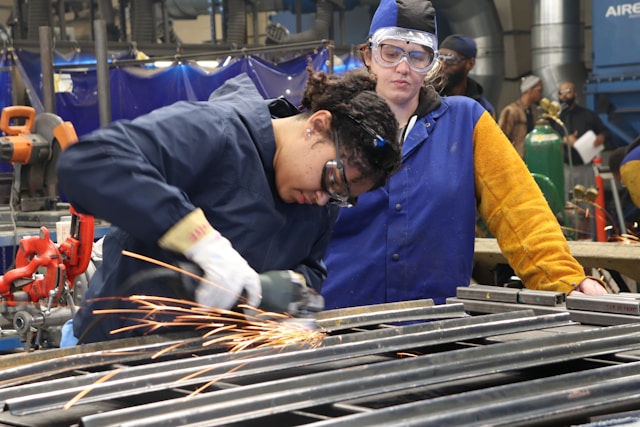
As U.S. manufacturers strive to regain their footing in a global economy marked by rising tariffs, disrupted supply chains, and reshoring imperatives, many are running into a serious roadblock: a deepening shortage of skilled labor. As we discussed in our series on manufacturing workforce challenges, the manufacturing sector has sounded the alarm for years over a widening skills gap—one that threatens to slow production, delay investments, and undercut the nation’s momentum in bringing industrial jobs back to American soil.
Despite efforts to incentivize domestic production and reduce reliance on foreign manufacturing through trade policies and tariffs, U.S. companies are finding it increasingly difficult to staff their operations with workers who have the technical skills needed in today’s high-tech industrial environment. From welders and machinists to automation specialists and maintenance technicians, the demand for talent far exceeds the supply. Unfilled positions have risen to historic highs in the post-pandemic era and have remained elevated, as manufacturing becomes more advanced and workers more scarce.
In response to these pressures, President Donald Trump recently signed a new executive order on April 23, 2025, titled “Preparing Americans for High-Paying Skilled Trade Jobs of the Future.” The initiative is designed to overhaul federal workforce development programs and better align them with the realities of a reindustrializing America. But will this really work? Today, we’ll explore the details of this ambitious plan.
A Closer Look: What's in the Executive Order?
1. A Sweeping Review of Federal Workforce Programs
The order tasks the Departments of Labor, Commerce, and Education with conducting a top-to-bottom review of all federal workforce development efforts within 90 days. The goal: identify redundancies, eliminate inefficiencies, and restructure programs to better serve industries where demand for skilled workers is greatest.
2. A Nationwide Push to Modernize Apprenticeships
One of the most significant components of the executive order is a plan to expand the number of registered apprenticeships to over one million active participants—a substantial increase aimed at easing the workforce bottleneck that many manufacturers are experiencing.
While apprenticeships have long been a cornerstone of workforce development in traditional trades like welding, machining, and electrical work, the Trump administration’s directive calls for a modernization and expansion of the apprenticeship model to reflect today’s industrial needs. This includes a deliberate push into emerging sectors such as advanced manufacturing, robotics, semiconductor fabrication, electric vehicle production, and clean energy technologies—industries that are rapidly growing but struggling to find workers with up-to-date technical skills.
The order also emphasizes the need to standardize and scale successful regional training models to the national level. Programs that have shown strong outcomes in individual states or metro areas—such as those led by industry-academic partnerships, technical colleges, or manufacturing consortia—could now receive federal backing to replicate their approach across the country.
Importantly, the administration is signaling a desire to make apprenticeships more accessible and appealing to younger Americans, as well as to career changers and displaced workers. By focusing on hands-on, earn-while-you-learn models, the initiative aims to create new pathways into high-paying industrial careers without requiring a traditional four-year degree—an attractive option as more students and families weigh the ROI of higher education.
Related: The Toolbelt Generation: Why Gen Z is Gearing Up for Skilled Trades
For U.S. manufacturers, this represents a potential turning point. Companies may gain greater access to federally supported training pipelines, tax credits, and workforce partnerships that can reduce onboarding time and close skill gaps faster. The order also positions manufacturers as key stakeholders, inviting them to help shape curriculum, define competencies, and mentor the next generation of skilled labor.
The real question going forward will be execution: How quickly can these apprenticeships be scaled? Will funding match ambition? And will manufacturers be ready to step up as partners in building the industrial workforce of the future?
3. Support for Alternative Credentials and Upskilling
Recognizing that the traditional four-year degree isn’t always the best path into the workforce, the order emphasizes the value of alternative credentials—certifications, on-the-job training, and other skill-based pathways. It also calls for upskilling current workers to help them stay competitive as automation, AI, and advanced manufacturing technologies reshape the shop floor.
Why This Matters for U.S. Manufacturers
This executive order comes at a critical juncture for American industry. A 2024 study by The Manufacturing Institute estimated that over 3.8 million manufacturing jobs could go unfilled by 2033 due to a shortage of skilled talent. Despite offering wages well above the national average—roughly $35/hour according to Labor Department data—many manufacturers still struggle to find qualified candidates for essential roles.
Compounding this challenge is the push to reshore operations that had previously moved overseas. As more companies bring production back to the U.S. in response to geopolitical instability and tariff-driven cost changes, the need for a robust, job-ready workforce becomes all the more urgent.
Manufacturers should take note of this shift in federal workforce strategy. While the executive order has received praise from industry groups for its focus on apprenticeships and skill-based training, concerns remain about how these initiatives will be funded—particularly given recent proposals to reduce budgets for longstanding programs like Job Corps.
What’s Next for Employers?
Manufacturers would be wise to track the implementation of this executive order closely. Opportunities may emerge to:
• Partner with government-backed apprenticeship programs
• Influence the design of new workforce training pathways
• Align their internal talent strategies with evolving credential standards
As the federal government recalibrates its approach to workforce development, industry leaders have a chance to help shape a system that delivers the skilled labor pipeline American manufacturing so urgently needs.
Manufacturers Need Workers…And the Materials, Products, Parts & Services to Keep Moving
While the workforce challenge grows, one thing you can count on is a strong supply network.
IndustryNet connects you with hundreds of thousands of U.S. manufacturers and industrial suppliers—fast. Search, source, and quote for free on America’s most trusted industrial marketplace.
Looking to help manufacturers with their workforce challenges? Powered by the same hands-on research that drives IndustryNet, the industrial marketplace, IndustrySelect is the nation's most accurate and comprehensive industrial sales and marketing platform, helping companies identify and contact prospects in manufacturing. Explore our range of databases by industry, region, niche market, and executive type or start your free demo, loaded with 500 real company profiles so you can test all the features of this powerful software!
