


Industrial automation has accelerated at a pace few could have predicted. Robots have moved from doing single, repetitive tasks on automotive lines to orchestrating entire operations with minimal human intervention. As the automation age accelerates, the question isn’t whether robots will become central to manufacturing; the focus is on how far and how fast they will continue to evolve. Here’s a look at the key trends that will shape the next generation of industrial robotics.
Modular Robotic Systems: Building Blocks for Adaptability
Traditional industrial robots are often designed for a single purpose and can require weeks of integration. That is changing with the rise of modular robotic systems—flexible platforms that can be reconfigured for different tasks by swapping out end effectors or adding new modules. In the garment sector, for example, CreateMe’s MeRA (Modular Engineering Robotic Assembly) system replaces sewing with precise adhesive bonding. The platform uses AI and machine learning to print microscopic dots of bonding agents and assemble garments up to 20 times faster than traditional sewing. Because the modules can be rearranged or upgraded as needed, companies can quickly adjust to new product designs or volume changes without installing entirely new equipment.
Modularity isn’t confined to textiles. The same concept is being applied in electronics and consumer goods factories where lines must pivot rapidly to accommodate short product life cycles. An ecosystem of plug and play robot modules is emerging, allowing manufacturers to compose assembly lines like Lego sets, which dramatically lowers the barrier to automation for small and medium sized enterprises.
AI Enabled Quality Inspection
As product complexity increases, quality assurance becomes more difficult for human inspectors. Artificial intelligence paired with machine vision is enabling robots to detect surface defects, alignment issues and sub millimetre deviations in real time. In MG Motor’s Halol, India battery assembly plant, a high precision laser welding robot ensures microscopic accuracy when welding connections between battery cells. Automated inspection systems are trained on thousands of examples to recognize subtle defects that humans might miss, reducing scrap rates and preventing faulty products from moving further down the line.
In the coming years, AI will not only identify defects but also predict when parts are likely to fail. Connected robots will feed data into predictive maintenance systems that schedule repairs or component replacements before breakdowns occur. For manufacturers, this means less unplanned downtime and higher yields.
Mobile Robots for Intralogistics
Intralogistics—the movement of parts and materials within a facility—is often overlooked, yet it represents a significant portion of manufacturing costs. Autonomous mobile robots (AMRs) and automated guided vehicles (AGVs) are transforming these internal logistics. Xiaomi’s mega EV factory near Beijing provides a glimpse of the future: automated guided vehicles resembling robotic vacuum cleaners transport parts across an area the size of 100 football fields. More than 700 robots handle body assembly and quality checks. Robots even align and install doors and autonomously move completed vehicles through light tunnel inspections, eliminating tasks that traditionally required human drivers.
These mobile platforms are becoming smarter and safer, with improved sensors and navigation algorithms that enable them to work alongside people without physical barriers. As costs decline, AMRs are moving beyond large scale factories into mid sized plants and warehouses.
Sustainable Production through Robotics
Automation isn’t solely about efficiency; it can also be a tool for sustainability. CreateMe’s adhesive based garment assembly demonstrates how robotics can embed recyclability into product design. The company’s Thermo(re)set platform uses reversible adhesives that allow garments to be disassembled and recycled, aligning with emerging Extended Producer Responsibility laws. Robotic precision reduces material waste during assembly, and robots operate more energy efficiently than many legacy processes.
Robots also enable lean, just in time manufacturing. By producing goods closer to consumer demand, companies can avoid overproduction and reduce inventory-related waste. As sustainability regulations tighten and consumer expectations evolve, robotics will play a crucial role in meeting environmental goals.
Global Adoption and the Race for Leadership
The competition to automate is heating up worldwide. China has rapidly become the heavyweight champion of industrial robotics. According to the International Federation of Robotics (IFR), Chinese factories installed nearly 300 000 new industrial robots last year, while the United States added about 34 000. China now operates more than two million industrial robots. This explosive growth is part of Beijing’s “Made in China 2025” initiative, which made robotics a strategic priority and provided massive investments and incentives.
Japan and South Korea remain leaders in robot density, and European manufacturers are increasing adoption to mitigate labor shortages and bolster competitiveness. These regional differences shape supplier capabilities, influence lead times and affect long term supply chain resilience.
The Human Factor: Safety and Workforce Evolution
Robots are not a panacea; they bring new challenges. A high profile lawsuit filed by a Tesla assembly line technician underscores the importance of safety in highly automated plants. The complaint alleges that a robot arm, improperly de energized, released an eight ton counterweight and knocked the technician unconscious. As robots become more prevalent, manufacturers need to rigorously implement lockout/tagout procedures, train workers on robot interactions and design systems to fail safely.
Automation also shifts workforce needs. Engineers and operators increasingly require skills in robotics programming, data analysis and system integration. Companies that invest in upskilling will be better positioned to leverage advanced automation while maintaining morale and engagement among employees.
Checking In on U.S. Robotics Suppliers
If you’ve ever wondered just how deep America’s robotics bench goes, a quick scan of robotics suppliers on IndustryNet paints a fascinating picture. Automation isn’t just for the big players; regional manufacturers are adopting sophisticated robotics to compete on quality, turnaround time and cost. On one end of the spectrum are firms like SPEN TECH Machine Engineering Corp. in Flint, Michigan, which designs and builds entire material handling systems, fluid dispensing units and custom robotic integration projects. On the other, you’ll find fabricators such as Banner Metals Group and Clipper Industries that combine heavy gauge stampings with robotic welding and laser cutting services to deliver precision parts.
Sprinkled between these extremes are dozens of smaller operations, offering everything from custom end of arm tooling and safety guarding to vision inspection systems and programming support. The breadth of services underscores how the U.S. robotics ecosystem has matured to support manufacturers of every size and need.
A good example of this variety is Alliance Fabrication & Manufacturing, a mid sized fabricator in Gary, Indiana. Alliance has invested heavily in automation, operating multiple robotic welding cells equipped with Fanuc Arc Mate robots, Fronius power supplies and H type positioners. These high speed, six axis machines are programmed offline so engineers can simulate weld paths and iron out issues before production begins, boosting productivity and consistency. Check out their fascinating video below:
The company touts its robotic welding service as delivering accurate, repeatable welds on materials ranging from hot rolled and cold rolled steel to aluminum and galvanized steel. Alliance also backs up its automation with a robust quality program that includes integrated QA software, precision measurement instruments and certified welding inspectors.
Another standout is Riverside Integrated Solutions (RIS) in Lewiston, Minnesota, which recently shared how it’s using collaborative robots, or cobots, to streamline complex production processes. As electronics shrink and assemblies grow more intricate, Riverside’s engineers have integrated cobots for precision potting and soldering operations—cutting soldering time from nearly an hour to just seven minutes. These cobots handle the repetitive, detail-driven work while human operators oversee setup, supervision, and quality assurance. The result is faster production, improved consistency, and reduced fatigue across shifts.
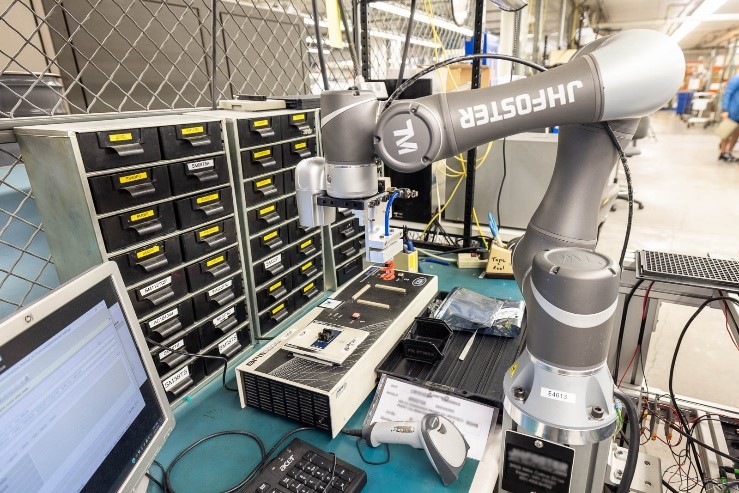
Rather than replacing human labor, Riverside’s cobots work side by side with skilled technicians to enhance speed, accuracy, and scalability—demonstrating how automation and craftsmanship can coexist on the same factory floor. As the company put it, “It’s not just about having the latest technology; it’s about knowing how to apply it.”
Together, these stories illustrate how U.S. robotics suppliers, large and small, are pushing automation forward, one process at a time.
Looking Ahead
Industrial robotics is entering a new phase characterized by flexibility, intelligence and sustainability. Modular robots will allow manufacturers to reconfigure lines rapidly. AI will make quality assurance predictive and precise. Mobile robots will streamline intralogistics. Sustainable design practices will become integral to automated systems. Meanwhile, the global race for robot adoption is accelerating, with China setting the pace.
For manufacturers, engineers and sourcing professionals, staying informed about these trends is essential. The future belongs to those who can strategically integrate robotics and adapt to a terrain where automation is a fundamental requirement.
