

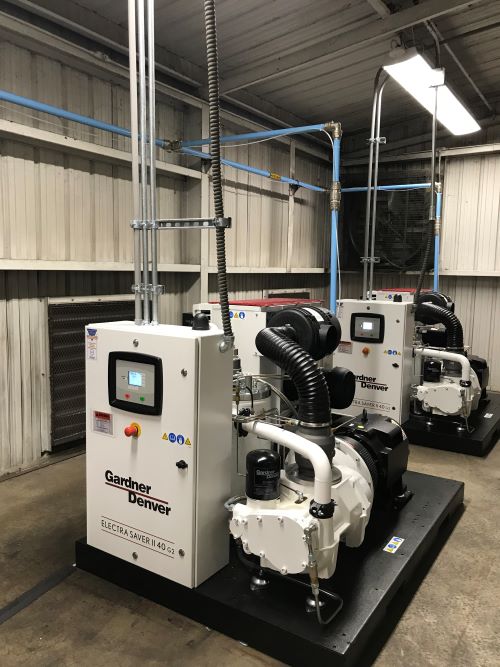
A Department of Energy study shows that about 10% of all industrial electricity is consumer by compressed air systems. Industry as a whole consumes approximately $60 billion worth of electricity each year. So that means each year in the USA, collectively forks over about $6 billion to power their compressed air systems.
When you break down where that compressed air goes, only 50% of the compressed air produced each year is actually used for production.
The other 50% is wasted. Every year we collectively waste about $3 billion of compressed air on leaks (28% of total consumption), generating excessive system pressure (15%) and inappropriate uses such as powering idle equipment, open drains, condensate removals shafts, air motors or air hose blowing and finally personal cooling (7%).
To say that compressed air systems are very inefficient is an understatement. The merchant, John Wannamaker once quipped that “Half of my advertising budget is wasted, I just don’t know which half.” Implying that if he knew what worked and what was being wasted he would be able either double his effective advertising or cut his spend in half and still get the same result.
For many plants today, they don’t have a shortage of compressed air they actually have an abundance of compressed air, they just aren’t using it efficiently.
Unfortunately for John, this was not possible in the murky world of advertising. However, in the world of compressed air it is very possible to determine which compressed air is being wasted and which compressed air is being used for actual production. This is because compressed air operates in an enclosed system where everything can be measured to the last cubic inch. Even the leaks.
Once it can be measured and quantified it can be improved.
As a supplier of compressed air systems and air compressors, when a client comes to us and asks for a new compressor, it’s the easy route to just provide a new compressor rather than taking a holistic approach for the client figure out what’s in their best interests and to see if we can reduce demand for a fraction of the cost and eliminate the need for a new compressor right now.
In the long run, everyone wins when you take that approach. With that said let’s explore:
What Are The Sources Of Waste In A Compressed Air System?
1. Leaks – Leaks can occur anywhere in the compressed air system and require ultra-sonic leak detection in order to locate. The most likely source of leaks is the 30 ft between the main distribution headers and the operating equipment. Referred to as the dirty 30, it includes pipe runs and associated items such as valves, pressure regulators, filters, lubricators, quick disconnects, hoses and flexible connections.
Often times the dirty 30 is assembled from what is at hand rather than the best components for the job often to get the system commissioned on time or back up and running as quickly as possible.
The wrong components increase the changes of leaks developing over time, the more leaks the more waste.
Leaks can create a variety of flow-on system operating issues, such as:
• Fluctuating system pressure causing air-operated equipment such as air tools to perform less efficiently which in turn forces operators to increase the system pressure to compensate
• Generating additional capacity to deal with the losses
• Diminished service life and maintenance of supply equipment resulting from unnecessary cycling and increased run time.
These problems affect production, increase maintenance and operating costs, and decrease service life. Simply identifying leaks is an important part of the compressed air optimization process but it is not the whole story.
2. Lack of Maintenance – Deferring compressed air system maintenance can have a significant impact on energy consumption. Ignoring maintenance will cause inconsistencies with:
• Compression efficiency
• Pressure variability
• Operating temperatures
• Moisture control
• Contamination levels
Savings in the short run by deferring maintenance will almost certainly cause expensive problems in the future. Simple cleaning or small adjustments can prohibit the need for future replacements.
Regular maintenance of the compressed air system will allow you to identify issues that lead to wasted energy and to run their process at the lowest, most efficient cost.
3. Pipe Sizing and Storage Issues – Many of these manufacturers struggle with compressed air piping size issues. Factory expansions, adding extra equipment, or air tools can cause the existing piping to be too small to handle the increase in demand.
Again the Dirty 30 can be a major source of pipe size issues. Pipes here can be frequently undersized because the installer or designer based the selection on the expected average compressed air demand only, but didn’t take into consideration the rate of flow.
Pipes need to accommodate peak rates of flow, not the average.
When only the average is accommodated, again the easy fix is just to increase the rate of flow from the compressor, consuming additional power and driving up operating costs.
Poor design piping can contribute to pressure drops across the system, a major cause of performance issues of the end use equipment.
4. Pressure Settings – Running compressors at the required pressure is essential to their longevity. Running systems at higher pressures increases the workload of the system and can lead to failure. Exceeding pressure limits also wastes energy and increases energy costs.
As the pressure settings get turned up to cope, it forces more compressed air out through leaks, which again drives up operating costs.
5. Controls / VSD’s – Having the right controllers, programmed correctly to meet your demand and drives for each compressor, can go a long way to generating compressed air when you need it. Without them, compressors can be running when there isn’t sufficient demand to warrant them operating or running when there is zero demand for compressed air.
The more the compressor runs the more compressed air is pushed out through the leaks in the system.
As you can see each issue creates additional problems which increases wasteful power consumption, pushes more compressed air through leaks and drive up operating costs.
It’s easy to see how American industry collectively wastes $3 billion of compressed air each year.
Thankfully, you and your plant don’t have to just accept all this waste. Taking a systemic approach to reducing waste can save plants a lot of capital and operating costs by eliminating the wasteful uses of their compressed air.
Introducing Pye-Barker’s Existing Compressed Air Optimization Services.
A 50hp compressor represents a $20,000 to $40,000 investment. The power bill can clock in at up to $43,800 per year plus maintenance can run at an additional $2,000 to $4,000 per year.
Over a 10 year service life, your compressor may actually represent a $575,000 cost (assuming an annual power cost of $35,000 over its 15 years, $2,000 per year maintenance and a $20,000 purchase).
Remember that about 50% of a typical compressor’s power consumption is waste. Over it’s life you can choose to spend so that means that $287,500 of the power bill over it’s life can be saved by being a bit smarter during commissioning and focusing on reducing waste.
Plus the reduced work load for the compressor will extend service life and reduce maintenance costs on top of the direct power savings.
What would clawing back about $20,000 a year mean for your business?
The challenge has been in the past that too many optimization programs were actually implemented haphazardly and didn’t cover the whole of the compressed air system which prevented these sorts of savings from being realized. Too often when a provider offers optimization they are really just doing leak detection. Meanwhile leak detection services don’t concern themselves with the optimizing your compressed air system.
The Department of Energy’s methodology to optimize compressed air systems is the best set of guidelines in the market at the moment. It all begins with a compressed air audit which is your game plan for optimizing your compressed air system.
What Should A Compressed Air Audit Deliver?
A clear baseline of your system’s performance. This will show you current costs, where air is being consumed and how much. A good compressed air system should experience a pressure drop of less than 10% of the discharge pressure from output to the end point of use.
It should also map out the demands of the compressed air system in terms of both quality and quantity. There can be significant costs associated with delivering higher quality air to an application than necessary for almost zero additional gains.
An outline of potential inappropriate uses of compressed air. Everyone of these is an opportunity to reduce compressed consumption, which in turn frees up capacity of your existing system to be used more productively. There are a surprising number of common uses of compressed air where an alternative piece of equipment can be used which is much cheaper to operate compared with using compressed air.
Leak Detection. While simply coating your compressed air lines with soapy water will reveal all the leaks but it can be time consuming. It’s far faster to identify leaks with ultrasonic leak detection. This will allow a plant to catalogue the sources of their compressed air leaks. Fixes may be as simple as tightening connections all the way through to replacing faulty equipment.
The savings from fixing your leaks in most cases will pay for the entire process. Ongoing leak detection is a must.
Plans To Combat Pressure Drop. Where pressure drop is a problem the following remedies may be needed depending on the causes of the problems; piping design, assessing treatment equipment, making sure regulators, lubricators, hoses and connections are appropriate for their place in the system.
Supply Side Considerations. As demand decreases it opens up more options to consume less power and reduce waste. Options might include retrofitting controls, or using your existing control systems can reduce compressor operation to match troughs in demand, adding receiving tanks to buffer supply so that a compressor doesn’t have to start up as often.
Suggestions for reducing the power consumption of compressors really is a case by case process.
This should also cover future proofing to handle those inevitable expansions.
Don’t forget all that heat. A compressed air system generates a lot of heat. That heat can be an input somewhere else in the plant. At the very least it might mean free hot water for the staff.
A plan to obtain and maintain peak performance. There’s no point in compiling a list of good ideas if they don’t get implemented and there is no point making all these improvements to only gradually slide back to where you started or worse.
Implementing A Compressed Air Optimization Strategy Results In:
Less wasted energy. If your compressed air energy bill is $50,000 there is a good chance that there is about $25,000 of waste in that number. Identifying the waste and eliminating it comes back to you in direct savings.
Longer Service Life. As demand goes down the wear and tear on your compressed air system goes down leading to a reduced wear and tear on the compressor.
This will result in the compressor running for longer with lower maintenance costs, reducing total cost of ownership and freeing up more money.
End Use Applications Working More Efficiently. When the right pressure arrives at each outlet then the application will operate as specified, which in turn should see lower operating costs, less breakdowns and more productivity.
Obviously there are lots of companies promising to do compressed air audits or leak detection. That is only part of the process. In order to get the results you need to work with a partner who can help diagnose and then prescribe an action plan that will get your compressed air system working at peak efficiency for you.
Ideally they can actually do the improvements for you rather than leave your poor overworked maintenance team to do all the work.
This is why Pye-Barker offers a complete Compressed Air System Optimization Service.
About Pye-Barker’s Compressed Air System Optimization.
Pye-Barker can advise you on the design, specification, provide all the parts for the system, install them and maintain them for you. If you have an existing compressed air system our first step in working together is a compressed air optimization audit.
That way we can drive down your compressed air costs and create additional capacity for you at a fraction of the costs of buying a new compressor.
We have 150 years of engineering experience across every part of the compressed air industry. On one client site we oversee the production of 7,300 CFM of compressed air and we work with clients running a single small compressor.
What To Do Next
Call 404-363-6000, send an email to sales@pyebarker.com or go to https://pyebarker.com/compressor-quote/ in order to talk to one of our Compressed Air Specialists to discuss how to get started with your compressed air system optimization process.
Have expert industrial advice like this to share? Learn about publishing on IndustryNet.
