

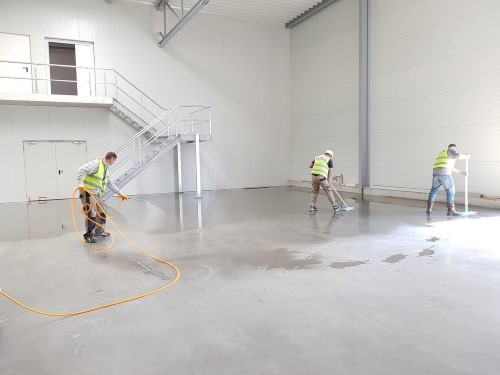
Thanks to its durability and cost-effectiveness, concrete has always been a go-to flooring choice and building material for warehouses and manufacturing facilities. Today, due to the rise in polished finishes, concrete is becoming even more widespread.
One significant benefit to concrete is that it’s a relatively low-maintenance flooring type.
It doesn’t require a ton of upkeep compared to alternatives like hardwood or tile. However, just because the maintenance is minimal, it doesn’t mean that you don’t have to put any care into maintaining concrete.
These simple tips are ways to keep your building’s concrete in great shape.
Tip #1: Seal the Concrete
Concrete at face value is incredibly porous, so it has the propensity to absorb moisture and debris. Once water or grime makes its way into concrete, it can cause lasting and costly damage. Applying a sealant helps to keep water and debris out of the concrete floor. It also makes cleaning much more manageable.
Sealants also help protect the concrete floors from UV rays, freeze and thaw cycles, and more.
There are several different sealants on the market. From epoxy sealants to acrylic sealants to more chemical-blocking sealants, there’s no shortage of options.
The important thing is that you seal the concrete and reseal it as needed. But we’ll talk more about that in a bit.
Tip #2: Clean it Regularly
Just like with any flooring, concrete needs to be cleaned. However, you can’t just use a bucket of water and a mop. Well, you can, but it isn’t best practice. Instead, opt for a cleaning schedule that utilizes appropriate equipment and products.
For instance, concrete floors should be swept every day. If they aren’t, dust can build up pretty quickly and cause cleaning headaches down the line. Plus, a dusty concrete floor can make operating machinery much more difficult. If sweeping isn’t practical or efficient, because your building produces a lot of dirt and debris, consider an industrial vacuum, instead.
Then, at least once a week, it’s imperative to scrub the floors. Select a cleaning product that’s specially formulated for concrete. Moreover, be sure you’re using a cleaner meant for your concrete’s finish. For easier cleaning in larger areas, consider using a floor machine or automatic scrubber instead of trying to scrub the floors manually.
Tip #3: Check for Wear and Tear
Concrete can crack for a variety of reasons. Sometimes it’s from poor installation. Other times, though, it’s from things like expansion, overloading, drying, settling, or heaving. You must frequently check for cracks. There’s no easy solution to repair them, but the sooner you spot a crack, the quicker you can get it replaced. You’ll want to stay on top of repairing cracks because one small fracture can cause even bigger ones later on.
Beyond checking for cracks, you’ll want to inspect your sealant regularly. Sealants need to be replaced every so often. Some sealants last longer than others, but if you begin to see peeling or chips, it’s time to reseal. The crucial thing to keep in mind is that you’ll need to know how to remove concrete sealer before applying a new one.
You can’t simply apply a new sealant on top of the old one.
To keep your building’s concrete healthy, you should do regular inspections. Aside from cracks and sealants, keep an eye out for anything that looks strange, like the concrete changing colors. Prevention and quick repairs are some of the best things you can do to keep your concrete floors in great shape.
Tip #4: Choose Higher-Quality Cement and Sealants
We’ve talked a bit about different sealant types already, but the type you choose can make a significant impact on the longevity and health of your floors. If you want the most resistant seal, go with penetrating sealers, which can last for ten years or more. Acrylic sealants on the other hand, are much cheaper, but they only last about one to three years.
If you invest in a quality sealant from the start, you’ll ensure that your concrete stays healthier longer.
You can take it a step further and use higher quality cement. Go with something like geopolymer cement. Geopolymer cement is created by using completely green materials. So, they don’t use traditional Portland cement in the mix. Instead, many companies use organic materials and combine them with added ingredients to make the cement incredibly acid and heat resistant.
If you choose higher-quality cement and sealants, your concrete will last much longer and require much less upkeep. This same idea translates to cleaning solutions, cleaning equipment, and even the company that installs the concrete. If you invest in higher-quality solutions from the start, you can avoid significant and costly repairs down the road.
Keep Your Building’s Concrete Healthy

These are a few tips to help you maintain the health of your building’s concrete. Whether it’s the concrete floors, walls, or sidewalk, maintaining concrete shouldn’t be too difficult. Concrete is durable and low maintenance by its nature. Utilizing these simple tips will help ensure that your building’s concrete stays healthy longer.
About the Author
Matt Lee is the owner of the Innovative Building Materials blog and a content writer for the building materials industry. He is focused on helping fellow homeowners, contractors, and architects discover materials and methods of construction that save money, improve energy efficiency, and increase property value.
Have industry knowledge like this to share? IndustryNet can help you reach the right audience. Learn about our marketing solutions.
