


Casting is a cornerstone of modern manufacturing, playing a pivotal role in industries such as automotive, aerospace, energy, and construction. From precision investment castings for intricate components to robust sand castings for heavy machinery, U.S. casting suppliers are leading the way in innovation and craftsmanship.
Today, we’re taking a closer look at the industry, exploring the latest trends, statistics, and top suppliers in the castings world based on the key data points gathered directly from the 900+ U.S. suppliers of castings by MNI.
Key Facts about the U.S. Castings Industry
MNI, compiler and publisher of industrial business profiles for the U.S. industrial sector and informational engine behind IndustryNet, surveyed the nation’s more than 900 U.S. castings suppliers, directly collecting key data points on this essential industry:
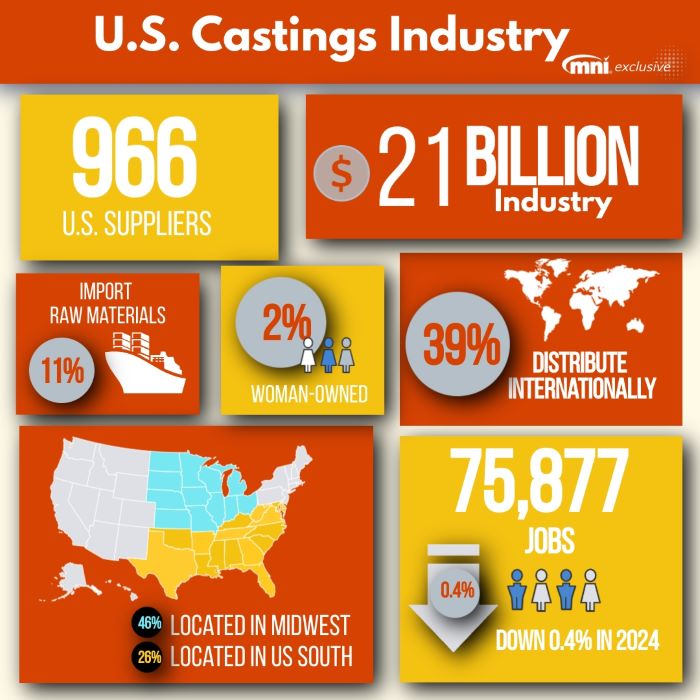
• There are currently 966 suppliers of castings in the U.S.
• 75,877 workers are employed in this essential industry.
• Employment among castings suppliers has decreased 0.4% over the past year (November 2023 to November 2024)
• Average reported sales for U.S. casting suppliers ran $21 billion 2023-2024.
• 104 or 11% of casting companies in the United States import raw materials
• 376 or 39% distribute internationally, running past the national average of 29%.
• The U.S. Midwest accounts for the most casting suppliers, encompassing 46%, followed by the U.S. South with 20%.
The Latest Trends in the U.S. Castings Industry
Adoption of Advanced Casting Technologies
The casting industry is undergoing a technological revolution with the integration of advanced manufacturing methods. One significant innovation is the use of 3D printing for creating molds and patterns. Unlike traditional methods that can be time-intensive and prone to inaccuracies, 3D printing allows for precise, complex geometries to be produced in a fraction of the time. This technology not only shortens lead times but also enables rapid prototyping, making it easier to test and refine designs before committing to full-scale production.
Another breakthrough is the widespread use of computer-aided simulation tools in the casting process. These tools allow manufacturers to model and predict how molten materials will flow and solidify within a mold, reducing defects such as porosity and incomplete fills. By optimizing designs digitally, manufacturers can minimize material waste, lower production costs, and enhance overall product performance. These innovations are particularly beneficial for industries like automotive and aerospace, where precision and efficiency are paramount.
Lightweight Materials and Alloy Innovations
The push for lightweight components has significantly influenced material selection in the casting industry. In response to demand from automotive and aerospace sectors, manufacturers are focusing on advanced materials such as aluminum, magnesium, and titanium alloys. These materials are prized for their high strength-to-weight ratios, offering the dual benefits of durability and reduced mass. For instance, lightweight aluminum alloys are now commonly used in engine components, while titanium castings are essential for high-performance aerospace applications.
These innovations align with efforts to improve fuel efficiency and sustainability. Lightweight materials not only enhance the energy efficiency of vehicles and aircraft but also help meet stringent emissions standards. As industries continue to prioritize performance and environmental impact, alloy development will remain a key focus for casting suppliers.
Sustainability in Casting Processes
Sustainability is no longer optional; it’s a necessity for modern foundries. The casting industry is adopting energy-efficient furnaces that use less fuel and produce lower emissions. These advanced furnaces can maintain consistent temperatures, resulting in better energy utilization and reduced environmental impact.
Additionally, many foundries are incorporating recycling practices by reusing scrap metals from production or post-consumer sources. This reduces the demand for raw materials and lowers overall carbon footprints. Another sustainable innovation is the use of biodegradable binders for molds, which reduce the amount of waste generated during the casting process.
Foundries are also exploring renewable energy sources, such as solar or wind power, to further decrease their reliance on fossil fuels. Together, these efforts demonstrate the casting industry’s commitment to environmental stewardship while meeting the increasing regulatory and consumer demands for sustainable practices.
Customization and Shorter Lead Times
Customization has become a critical differentiator in the casting market. Industries ranging from medical devices to automotive manufacturing require tailor-made components that meet specific design and performance criteria. To address this need, suppliers are investing in flexible production technologies that allow for quick transitions between different casting configurations.
Digital technologies, such as automated mold design and real-time monitoring systems, have enabled suppliers to reduce production times significantly. These tools ensure consistent quality even for highly customized orders, minimizing the risk of delays. By prioritizing efficiency and adaptability, casting suppliers can meet the growing demand for individualized solutions without compromising on lead times.
Increased Use of Automation
Automation is transforming the casting industry by streamlining labor-intensive processes. Robots are now widely employed for tasks such as mold preparation, pouring molten materials, and finishing castings. This automation not only enhances precision but also reduces the likelihood of errors caused by manual handling.
Automation technologies also play a key role in monitoring and quality assurance. Sensors embedded within production lines provide real-time data on temperature, pressure, and material flow, allowing for immediate adjustments to prevent defects. By leveraging automation, foundries can achieve higher throughput, improve product consistency, and enhance worker safety by reducing exposure to hazardous environments.
Reshoring of Casting Operations
The disruptions caused by global supply chain challenges have prompted many companies to reevaluate their sourcing strategies. Reshoring has emerged as a significant trend in the U.S. casting industry, driven by the need to reduce lead times, ensure reliable deliveries, and mitigate the risks of geopolitical instability. Sourcing castings domestically allows manufacturers to avoid the unpredictability of international shipping delays and better control quality standards.
In addition to supply chain considerations, the potential for new tariffs and trade policies under the incoming Trump administration is influencing reshoring decisions. If tariffs on imported goods, including castings and raw materials, are introduced or increased, companies relying on overseas suppliers could face higher costs. This prospect makes domestic sourcing more attractive, as it provides financial predictability and shields businesses from sudden price hikes due to regulatory changes.
Moreover, reshoring supports closer collaboration between casting suppliers and manufacturers, enabling faster communication, better customization, and quicker problem-solving. It also aligns with sustainability goals by reducing the carbon footprint associated with long-distance shipping. As businesses prioritize supply chain resilience and cost efficiency, the reshoring of casting operations is likely to remain a pivotal trend in the industry.
IndustryNet’s Top Castings Suppliers
The U.S. casting industry plays an important role in supporting a wide array of manufacturing sectors, from automotive to aerospace and beyond. This week, we shine a spotlight on IndustryNet’s top castings suppliers, celebrating the companies that exemplify innovation, quality, and customer-centric service.
This curated selection features some of the most prominent names in the casting industry, showcasing their expertise in producing high-quality components through various casting methods such as sand, die, and investment casting. Whether you're seeking lightweight alloys for aerospace applications, durable iron castings for industrial use, or custom solutions for specialized projects, these suppliers represent the pinnacle of American craftsmanship and technological advancement.
Modern Aluminum Castings Co., Inc. (Terre Haute, IN) Modern Aluminum Castings Co., Inc. has been a leader in the aluminum casting industry since 1919. Located in Terre Haute, Indiana, they specialize in aluminum sand, die, and sub-assemblies, providing high-quality castings for a variety of industries. Their commitment to innovation and customer satisfaction has made them a trusted name in the field.
EXCAL Inc. (Mills, WY) EXCAL Inc. is a premier foundry and machine shop based in Mills, Wyoming. They specialize in brass sand castings and offer a wide range of services, including pattern making and CNC machining. EXCAL is known for its high-quality castings and dedication to meeting customer needs.
Southeastern Pipe & Drain, Inc. (Aiken, SC) Southeastern Pipe & Drain, Inc. manufactures corrugated metal, aluminum, and galvanized steel pipes, as well as pond and lake drain systems. Based in Aiken, South Carolina, they provide innovative water control solutions, including pond risers and trash racks, ensuring reliable and efficient drainage systems.
Ultimate Casting & Machine, LLC (West Branch, MI) Ultimate Casting & Machine, LLC, located in West Branch, Michigan, offers a comprehensive range of sand castings in aluminum, brass, bronze, copper, grey, and ductile iron. Their in-house pattern shop and machining capabilities ensure high-quality, custom castings for various industrial applications.
Clark Casting, LLC (Baltic, OH) Clark Casting, LLC, based in Baltic, Ohio, specializes in custom aluminum sand castings. Serving a wide range of industries, they provide tailored solutions from small-batch production to large orders, ensuring high-quality and precision in every casting.
Craft Die Casting Corp. (Chicago, IL) Craft Die Casting Corp. has been a trusted name in zinc die casting since 1953. Located in Chicago, Illinois, they offer custom job shop services, specializing in high-precision zinc die castings for various industries. Their expertise and commitment to quality have made them a leader in the field.
Wear-Tek, Inc. (Spokane, WA) Wear-Tek, Inc., based in Spokane, Washington, specializes in wear and heat-resistant steel castings. They provide in-house machining and serve industries such as agriculture, aggregate, power, and cement, offering durable and high-performance castings.
Austin Foundry Corporation (Sheboygan, WI) Austin Foundry Corporation, located in Sheboygan, Wisconsin, produces high-quality gray and ductile iron castings. Established in 1946, they have a long history of providing reliable and precise castings for various industries, ensuring on-time delivery and exceptional customer service.
DECO Products Co. (Decorah, IA) DECO Products Co. is the largest stand-alone zinc die caster in the USA. Founded in 1960 and based in Decorah, Iowa, they offer full-service zinc die casting solutions, including casting, machining, powder coating, and assembly. Their engineering excellence and commitment to quality make them a global leader in zinc die casting.
Kettler Casting Co., Inc. (Belleville, IL) Kettler Casting Co., Inc., established in 1979, is a green sand gray and ductile iron foundry located in Belleville, Illinois. They offer a wide range of iron castings, from small to large sizes, and provide additional services such as machining and pattern making.
Kit’s Foundry & Machine, Inc. (Shelley, ID) Kit’s Foundry & Machine, Inc., based in Shelley, Idaho, specializes in cast iron and high alloy castings. They offer a variety of casting services, including ductile iron, manganese steel, and steel castings, catering to diverse industrial needs.
Mackenzie Castings (Arlington, WA) Mackenzie Castings, LLC, founded in 1977, is a leading custom manufacturer of steel and iron sand castings in the northwest United States. They produce high-quality castings for industries such as marine, construction, and agriculture.
St. Croix Castings, Inc. (Woodville, WI) St. Croix Castings, Inc., located in Woodville, Wisconsin, is a family-owned aluminum foundry offering medium to small volume aluminum castings in sand and permanent mold. They are known for their quality craftsmanship and customer service.
The Nelson Co., Inc. (Fairfield, IA) The Nelson Co., Inc., based in Fairfield, Iowa, specializes in machined aluminum, gray, and ductile iron castings. They offer precision machining services and have a strong reputation for quality and reliability.
AFK Corp. (Ripon, WI) AFK Corp., located in Ripon, Wisconsin, is a family-owned foundry specializing in gray and ductile iron castings. They utilize advanced molding automation to deliver high-quality castings for various industries.
Alumistar, Inc. (Ontario, CA) Alumistar, Inc., based in Ontario, California, offers aluminum castings made with sand molds or permanent molds. They provide high-quality aluminum components for industries such as aerospace, military, and automotive.
Donsco, Inc. (Wrightsville, PA) Donsco, Inc., located in Wrightsville, Pennsylvania, is a leading provider of cast, machined, and coated gray and ductile iron castings. They offer comprehensive foundry services, including CNC machining and pattern making.
J.R. Hoe & Sons, Inc. (Middlesboro, KY) J.R. Hoe & Sons, Inc., based in Middlesboro, Kentucky, manufactures construction site products, structural steel, and miscellaneous metals. They also provide industrial casting and machining services, catering to a wide range of industries.
Kiel Foundry Co., Inc. (Kiel, WI) Kiel Foundry Co., Inc., located in Kiel, Wisconsin, specializes in gray iron castings. They offer high-quality castings for various industrial applications and have a long-standing reputation for excellence.
Littlestown Foundry, Inc. (Littlestown, PA) Littlestown Foundry, Inc., based in Littlestown, Pennsylvania, specializes in aluminum sand castings. They provide custom casting solutions for a variety of industries, ensuring high-quality and precision.
Non-Ferrous Cast Alloys, Inc. (Norton Shores, MI) Non-Ferrous Cast Alloys, Inc., located in Norton Shores, Michigan, offers high-quality aluminum and brass castings at competitive prices. They serve a wide range of industries with their precision casting services.
Pacific Cast Products (Ontario, CA) Pacific Cast Products, based in Ontario, California, specializes in aluminum castings up to 75 lbs. They provide high-quality castings for industries such as aerospace, automotive, and industrial.
Pier Foundry & Pattern Shop, Inc. (St. Paul, MN) Pier Foundry & Pattern Shop, Inc., located in St. Paul, Minnesota, is an ISO-certified provider of gray and ductile iron castings. They offer comprehensive foundry services, including pattern making and machining.
Premier Aluminum, LLC (Racine, WI) Premier Aluminum, LLC, based in Racine, Wisconsin, is an ISO 9001:2015 certified permanent mold aluminum casting and machine shop. They provide high-quality castings and machining services for various industries.
QCast Aluminum (New Berlin, PA) QCast Aluminum, located in New Berlin, Pennsylvania, is an ISO 9001 certified aluminum casting company. They offer high-quality castings and machining services for a variety of applications.
Rimer Enterprises, Inc. (Waterville, OH) Rimer Enterprises, Inc., based in Waterville, Ohio, specializes in low-alloy, aluminum, carbon, and stainless steel investment castings. They provide high-quality castings for industries such as aerospace, defense, and industrial.
See all 900+ U.S. castings suppliers on IndustryNet.
Quick-Start Guide to Choosing the Right Castings Supplier
Selecting a castings supplier is a critical decision that affects the quality, cost, and efficiency of your production. Now that you have a trusted resource for locating and contacting casting suppliers, here are the key considerations for what to look for in a casting supplier.
1. Material Expertise
Different casting processes and materials are suited for various applications. Ensure the supplier specializes in the type of casting (e.g., sand, die, or investment) and materials (e.g., ferrous or non-ferrous alloys) you require. A supplier with in-depth knowledge of material properties can help you choose the best option for your project.
2. Production Capacity
Whether you need low-volume prototypes or high-volume production, the supplier’s capacity should align with your needs. Evaluate their ability to scale up or down based on your production forecasts and project timelines.
3. Certifications and Standards
Compliance with industry certifications, such as ISO 9001 or NADCAP for aerospace applications, ensures quality and reliability. Make sure the supplier adheres to the specific standards relevant to your industry.
4. Customization and Design Support
For complex or custom projects, look for suppliers that offer design assistance, including casting simulation and prototyping. A collaborative supplier can help refine your designs for optimal performance and manufacturability.
5. Supply Chain and Lead Times
Choose a supplier with a robust supply chain and a proven track record of on-time deliveries. Domestic suppliers often offer faster turnaround and reduced shipping costs compared to international options.
6. Quality Assurance and Testing
Ensure the supplier has stringent quality control measures in place, including non-destructive testing (NDT) and chemical composition analysis. These steps are critical for industries like aerospace and medical, where failure is not an option.
7. Environmental Practices
If sustainability is a priority for your company, look for suppliers committed to environmentally friendly practices, such as using recycled materials and minimizing energy consumption.
8. Reputation and References
Investigate the supplier’s reputation by seeking reviews, case studies, or testimonials. Speaking with existing clients can provide valuable insights into the supplier’s reliability and performance.
By carefully evaluating these factors, you can select a casting supplier that meets your project’s requirements and contributes to the overall success of your operations.
Locating & Contacting Casting Suppliers
Looking for suppliers of castings? IndustryNet can help you narrow down your search for a domestic concrete supplier or any other type of local industrial supplier. Perform searches by company type, distribution, geography, specialty, and even ISO standards. Search, sort, and quote for free on America’s most-trusted industrial marketplace.
