

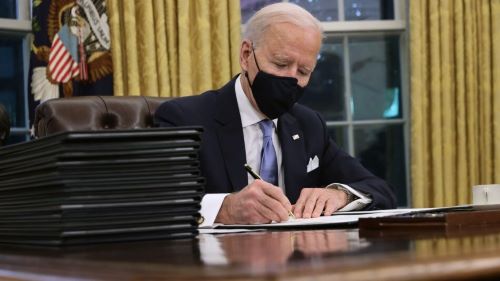
Photo Credit: The National Association of Manufacturers (NAM)
The Biden Administration has unveiled the details of its new Buy American Plan, laying out an agenda that aims to “ensure that our future is made in all of America by all of American workers”.
The plan, a component of Biden’s “Build Back Better” initiative, seeks to boost federal purchases of American-made goods, promote accountability in the federal purchasing process, and crack down on irrelevant waivers to the law, among other key points, laid out today in a statement Monday, January 25th. This is among a flurry of executive orders released by the Biden team since Inauguration Day, addressing the coronavirus pandemic, critical supply chain preparedness, new OSHA regulations and more – many of which will have a direct impact on U.S. manufacturing companies. So what’s in this new plan and how is it different from the Buy American policy established by the former Trump Administration?
The Buy American Plan: Biden's Version
If the idea of the Biden Buy American initiative gives you a sense of dèjá vu, there’s good reason: the Trump Administration released its own Buy American initiative shortly after Trump took office in 2017. Titled “Maximizing Use of American-Made Goods, Products, and Materials, the Trump plan essentially rehashed a Hoover era Buy America Act. With this, the Trump administration sought to increase the number of American-made products and components purchased by federal agencies, with the eventual goal of increasing the percentage of American-made components from 50% to 75%, and up to 95% for iron and steel.
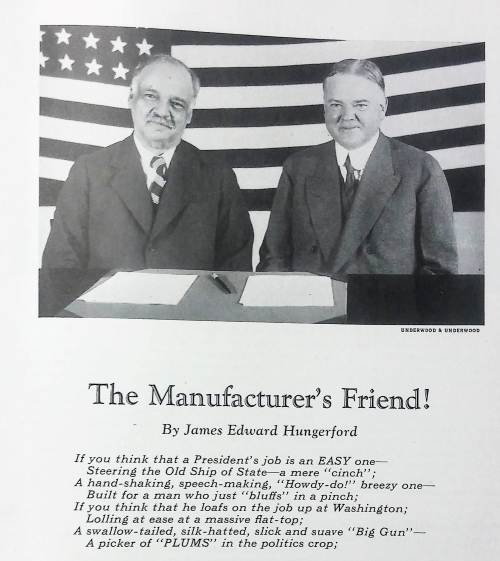
Above: A poem dedicated to Herbert Hoover, from Manufacturers' News, Inc. (MNI), 1930 edition.
For the most part, the Biden plan is not considerably different, with a few exceptions. The new executive order released today on Whitehouse,gov features the lofty and somewhat redundant headline “President Biden to Sign Executive Order Strengthening Buy American Provisions, Ensuring Future of America is Made in America by All of America’s Workers.”
It lays out a vision that includes more federal procurement and investment in American-made goods by American workers and with American-made component parts. Specifically, “These investments will help create well-paid, union jobs, and build our economy back better so that everybody has a fair shot at the middle class. They will buy from all of America—including minority entrepreneurs and businesses in every region in our country. And, they will support the manufacturing capabilities and technology needed to build a clean energy future and strengthen our national security, and give our workers and companies the tools they need to compete globally for decades to come.”
But how, specifically will the Biden plan accomplish this, and how does this differ from had already been in place? First off, the Biden plan will direct agencies to “close current loopholes in how domestic content is measured.” This seems to be in reference to the formerTrump agenda that laid out specific percentages of American-made content a given product had to contain in order to be considered American-made.
Without mentioning specifics, the Biden agenda plans to increase this threshold, so that a given product will need to contain more American-made material to be considered American made than what was required under the Trump plan.
This will be important for manufacturers with federal contracts that are currently utilizing some foreign-made components to produce their products. These companies may need to seek more domestic sources of materials or components, depending on what the final threshold numbers are.
According to Government Accountability Office, federal agencies spend nearly $600 billion on procurement contracts. The Department of Defense is the largest purchaser of manufactured goods and services.
Also different from the Trump-era agenda, which was largely executed at the cabinet level, Biden’s plan includes the creation of a new Director of Made-in-America role who will operate under the leadership of the Office of Management and Budget.
The Biden agenda also creates a central review of agency waivers, while approved waivers will be published on a public website. Federal agencies utilizing a waiver may find their current waiver under renewed scrutiny under this provision.
The new order also reiterates Biden’s support for the Jones Act, a component of the Merchant Marine Act of 1920 that requires all good shipped between U.S. ports to be vessels that are U.S. made and operated. This is nothing new, as the Jones Act has largely remained untouched, apart from a temporary waiver issued for Puerto Rico following the devastating hurricane than struck the country in 2017, and a near-miss in 2019 when petrochemical companies sought a waiver to the Jones Act as a means to boost exports of liquified natural gas (that measure was ultimately struck down). The reason why the Jones Act is mentioned in the Biden order is unclear, but possibly may be appearing to head off any movement by petrochemical companies to lobby for another waiver with the current administration.
As part of the push towards increasing federal purchases of American made goods, the new initiative also requires federal agencies to report on their implementation of the new American Made laws and also requires agencies to provide recommendations for increasing domestic sourcing. What’s interesting here is that this particular endeavor requires federal agencies consider both manufacturing and services in their assessments.
Broadly speaking, Biden’s Buy American plan does not look all that different from similar policies put in place by the Trump administration. However, the final provision laid out by Biden’s executive order, appears to be the most divergent. The new law proposes strengthening supply chains of international partners and allies and seems to be an effort to distance from the Trump-era “America-first” policies. Specifically, “The president remains committed to working with partner and allies to modernize international trade rules – including those related to government procurement – to make sure all countries can use their taxpayer dollars to spur investments in their own countries.”
Read More: How Will the Biden Presidency Impact U.S. Manufacturers?
Finding Domestic Suppliers
At MNI, our mission is to help U.S. businesses thrive, providing tried-and-true prospecting and procurement solutions since 1912. Powered by trusted MNI data, IndustryNet is an industrial marketplace that connects industrial buyers with 400,000 U.S. manufacturers and suppliers of more than 10,000 types of products and services. Set up a free account, search for suppliers, send quote requests and more with this free industrial marketplace.
Sources:
https://www.whitehouse.gov/briefing-room/statements-releases/2021/01/25/president-biden-to-sign-executive-order-strengthening-buy-american-provisions-ensuring-future-of-america-is-made-in-america-by-all-of-americas-workers/
https://www.vox.com/policy-and-politics/2017/9/27/16373484/jones-act-puerto-rico
https://www.investopedia.com/terms/j/jonesact.asp
https://www.professionalmariner.com/trump-pledges-not-to-waive-jones-act-for-lng-shipments/
https://blog.gao.gov/2020/05/26/a-snapshot-of-government-wide-contracting-for-fy-2019-infographic/
