

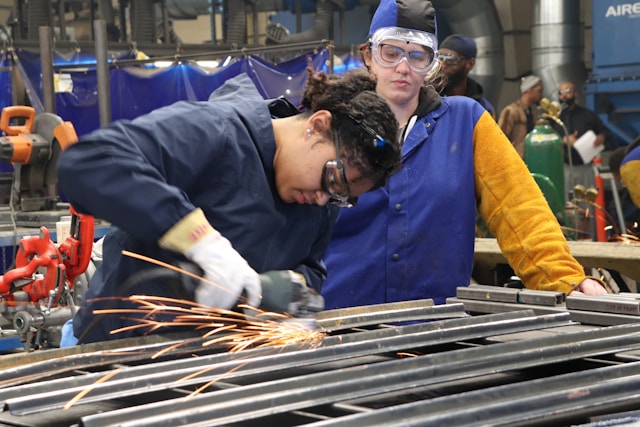
Could Generation Z be the answer to manufacturing’s persistent labor crunch? Recent trends support the idea that Gen Z, a tech-focused generation marked by economic insecurity and sustainability concerns, is setting its sights on the factory floor. This growing trend sees more Gen Z individuals (born after 1996) opting for trade schools and vocational training, embracing the moniker "The Toolbelt Generation." This shift is driven by several key factors that hold significant implications for the workforce, particularly the manufacturing sector.
With unfilled positions in the U.S. manufacturing sector persisting at historic highs over the past several years and companies plagued with a relentless skills gap, this is a key moment for the industry. So what’s behind the generational shift and how can manufacturers attract Gen Z workers? Let’s take a look:
Gen Z & Manufacturing: Trends and Statistics
A recent survey by Parsable, a provider of the Connected Worker® platform, shows a significant shift in Gen Z’s perception of the manufacturing industry. 83% of young adults aged 18-24 view manufacturing as high-tech and modern, a notable increase from 69% the previous year. Nearly half of the respondents consider manufacturing very important in today’s world.
Recent enrollment numbers support the trend of Generation Z (Gen Z) opting for trade schools over traditional four-year colleges. According to a report by the National Student Clearinghouse, vocational community college enrollment has grown 16% since 2018 and The National Student Clearinghouse Research Center recorded a 16% increase in enrollment last year at two-year schools with a focus on vocational programs. Meanwhile, the number of students studying construction trades rose 23% during that time, while programs covering HVAC and vehicle maintenance and repair increased by 7%.
These are some promising numbers for the industrial sector.
Why Manufacturing and Gen Z are a Perfect Match
Generation Z’s interest in manufacturing stems from a variety of factors. This digitally native generation is drawn to the technological advancements and innovation opportunities that modern manufacturing offers. They see it as a field where they can apply their tech-savvy skills, from robotics to 3D printing. Gen Z also values practical, hands-on work and problem-solving, both of which are integral to manufacturing roles.
As a case in point, Davis Latham, a 24-year-old Vice President of Operations at CADmore, is a prime example of Gen Z’s success in manufacturing. Starting his career at ZVerse, a digital manufacturing software developer, he climbed the ranks to his current position at CADmore, managing a team of designers and project managers. Latham’s rise to a VP role at such a young age demonstrates Gen Z’s potential when given the opportunity to show their abilities. His story serves as an inspiration for both employers and young professionals alike.
Or take the example of Daniel Huang, an 18-year-old from Florida, who is making significant contributions to the field of 3D printing. As the founder of his high school’s 3D printing club and a recognized SME “30 Under 30” honoree, Huang has demonstrated his innovative approach to manufacturing. His work includes research at the University of Florida Materials Science Lab, a stint at Georgia Tech’s Advanced Manufacturing Pilot Facility, and a proposal for customizable pills using 3D printing. Huang plans to further his education in materials science and engineering, with a focus on cybersecurity and 3D printing.
Economic Realities
Generation Z are facing unique economic challenges, entering the working world during a time of global upheaval, marked by a pandemic, rising inflation rates, recession fears, geopolitical conflicts, and climate change. This has led to high levels of economic insecurity among this generation. Many Gen Zers who are working are more likely to have independent jobs or multiple jobs than older workers. They are less likely to expect this period of financial insecurity to end and have high levels of doubts about their eventual ability to either buy homes or retire. A significant 77 percent of Gen Z respondents report looking for a new job, almost double the rate of other respondents. This economic pessimism suggests a deep malaise about their own prospects and those of other Americans.
However, trade schools offer a more direct path to employment, often at a fraction of the cost of a four-year college degree. With the average four-year private college degree costing roughly $146,000, the considerably cheaper $30,000 price tag for a trade school degree makes the choice a no-brainer for many Gen-Zers, who are increasingly wary of skyrocketing student debt.
Gen Z also appears to be more open to the idea of working in manufacturing compared to older generations. Manufacturing has historically been perceived as a low-skilled, dirty profession. However, that perception has shifted in recent years with the modern manufacturing environment far more tech-focused, offering a more relevant arena for a technologically driven generation.
“Gen Z increasingly views manufacturing as high-tech and modern, which is a step in the right direction for developing a resilient frontline workforce," said Matt Belkin, CEO of Parsable.
The Sustainability-First Generation
Generation Z, the demographic cohort following the Millennials, is known for its strong commitment to sustainability. This environmentally conscious generation is keen on driving change in all sectors, including manufacturing. They are interested in sustainable manufacturing practices that reduce waste and minimize environmental impact. This includes the use of renewable energy sources, recycling and upcycling, and the development of products that are durable and designed to be easily repaired or recycled. This not only aligns with their values but also opens up new opportunities for innovation and growth in the sector.
The Parsable study underscores Gen Z’s strong preference for environmentally responsible companies. A majority, 56%, would accept lower salaries to work for such companies, and 84% regard a company’s environmental and sustainability goals as crucial when job hunting. While 13% are hesitant about manufacturing careers due to perceived conflicts with their social responsibility values, more than not seem to feel they can make a difference in manufacturing.
Attracting Generation Z to the Manufacturing Sector
The rise of the 'Toolbelt Generation' is a testament to a critical shift in the workforce, where practical skills and digital fluency converge. Having taken a closer look at this phenomenon, a critical question arises: How can manufacturers attract the digitally-native Generation Z?
Understanding Gen Z's Core Values
To captivate Gen Z, manufacturers must align with their core values. This generation places a premium on environmental sustainability, and meaningful work. They seek employers whose principles resonate with their own, preferring companies that not only advocate for a better environment but also practice what they preach.
Innovative Recruitment Strategies
Manufacturers can leverage innovative recruitment strategies to appeal to Gen Z. For instance, Manufacturing Day events can serve as a platform to showcase advancements in the sector, connecting with schools and communities to ignite interest among young individuals. Additionally, by modernizing traditional processes into digital formats, manufacturers can demonstrate a commitment to operational efficiency and technological integration, which is highly attractive to Gen Z candidates. Parsable’s CEO, Matt Belkin, further emphasized the opportunity for manufacturers to attract Gen Z workers by leveraging digital tools. "Parsable's survey findings indicate a unique opportunity for companies to attract this generation into the industry through the use of digital tools that not only help younger workers advance their own industrial skill sets but can also help organizations gather invaluable frontline activity data.”
Offering Career Development and Flexibility
Career development opportunities and workplace flexibility are also significant draws for Gen Z. A study by McKinsey highlights that while compensation is important, factors such as career advancement, flexibility, and caring leadership are more influential in retaining Gen Z employees. Manufacturers must, therefore, create environments that foster growth and adapt to the changing expectations of this generation.
The Bottom Line
The rise of the Toolbelt Generation represents a significant shift in the workforce. It underscores the importance of skilled trades and challenges the traditional notion that a four-year college degree is the only path to success. Manufacturers and other industries reliant on skilled labor must adapt their strategies to attract and retain this generation of talented and tech-savvy workers.
Sources:
https://www.mckinsey.com/featured-insights/sustainable-inclusive-growth/future-of-america/how-does-gen-z-see-its-place-in-the-working-world-with-trepidation
https://www.rsi.edu/blog/skilled-trades/why-generation-z-is-choosing-trade-school-over-college/
https://www.mckinsey.com/featured-insights/sustainable-inclusive-growth/future-of-america/how-does-gen-z-see-its-place-in-the-working-world-with-trepidation
https://www.prnewswire.com/news-releases/survey-finds-gen-z-increasingly-views-frontline-manufacturing-as-important-high-tech-and-modern-301678609.html
https://buildops.com/resources/gen-z-tool-belt-generation/
https://www.forbes.com/sites/forbesbusinesscouncil/2021/10/06/gen-zers-the-future-of-manufacturing/?sh=7d860994631d
https://www.collegetuitioncompare.com/articles/average-cost-of-college/
https://www.manufacturing.net/gen-z-in-manufacturing-podcast/video/22889896/gen-z-in-manufacturing-a-sustainabilityfirst-generation-looks-to-influence-3d-printing
https://www.manufacturing.net/video/video/22881207/gen-z-in-manufacturing-gen-z-wants-more-responsibility-sense-of-purpose
