

What actually works for lean industrial teams
Every manufacturer has seen the headlines. AI will transform your operations. Automate your workflows. Revolutionize your supply chain. The advice keeps coming, from consultants, tech vendors, and business media, maybe even your twelve-year-old nephew...Yet, almost none of it reflects how manufacturing businesses actually work.
That disconnect is no accident.
Most AI guidance is written with a specific type of company in mind: one with dedicated marketing departments, full-time HR teams, IT administrators, and innovation committees with the bandwidth to run pilot programs. Sure, that company exists. Many companies like that exist. It's just not most manufacturers.
The Reality Behind the Numbers
According to data collected by MNI from more than 360,000 U.S. manufacturers and industrial suppliers:
- 81% of manufacturing firms employ fewer than 50 people
- 87% are privately held, with decision-making concentrated locally
- The median manufacturer has been in business for 41 years
- Nearly 89% have operated for more than two decades
Read those figures carefully. The typical U.S. manufacturer is a privately held company that has been running the same core business for four decades, with a workforce smaller than many office buildings' single floors. Decision-making authority sits with a small group of people who are directly involved in daily operations, not a corporate hierarchy or a technology steering committee. These are disciplined, experienced organizations where new tools are evaluated by one simple question: Will this help us run the business better?
When AI advice assumes large specialized teams, fast iteration, and low-consequence mistakes, it fails manufacturers before it even gets started. Oops.
And that context shapes everything about how new tools get evaluated. A manufacturer with 30 employees and 40 years of operational history is not going to restructure its workflows around a tool that promises transformation. It will ask whether the tool saves time, fits into existing processes, and can be trusted with real business information. If the answer to any of those questions is unclear, the tool doesn't get adopted.
The Five AI Assumptions That Fall Flat for Manufacturers
1. You have dedicated departments for this
Sure. Cue dramatic eye roll. Generic AI content routinely recommends tools for your marketing automation team, your HR department, your sales operations group. In most manufacturing companies, those functions are handled by one or two people, often the same person who is also managing production schedules and answering customer calls.
According to MNI data, 60% of manufacturers employ fewer than 20 people. In an organization that size, there are no departments in the traditional sense. There are people, and each of them covers a lot of ground. AI tools that require dedicated administrators, implementation teams, or ongoing governance structures simply don't fit that reality. The tool has to work for the person who is already doing three other jobs, or it won't get used.
AI that requires departmental infrastructure to operate simply doesn't fit.
2. You can move fast and fix it later
Famous last words. In many industries, a bad experiment is a minor setback. In manufacturing, errors cascade. Production schedules slip. Customer commitments are missed. Quality issues reach the floor. Companies with 40-plus years of hard-earned operational discipline don't adopt new tools recklessly, and they shouldn't. AI must be introduced incrementally, with clear boundaries and human review at every step.
3. A committee will champion this
Enterprise AI playbooks often call for steering committees and cross-functional task forces. In privately held manufacturing companies, the person who identifies a problem is usually the same person who approves the solution, and they're doing both jobs between production meetings. There's no room for abstract transformation roadmaps. Value has to be visible quickly.
4. Roles are clearly defined
A plant manager who also handles hiring. A sales leader who oversees customer onboarding and reviews contracts. An owner who participates in quoting and vendor negotiations. Role overlap in manufacturing is intentional, the result of disciplined cost control and deep operational knowledge. AI tools built around narrow job descriptions don't reflect how work actually gets done.
5. AI replaces the work
Perhaps the most persistent and damaging assumption in AI coverage is that the goal is replacement: replacing tasks, reducing headcount, automating away human effort. This framing is common in technology media and consulting, and it lands poorly in manufacturing environments.
Manufacturing businesses are built on accumulated expertise. The machinist who knows how a particular material behaves under specific conditions. The plant manager who can read a production floor and spot a problem before it shows up in the data. The sales leader who has maintained a customer relationship through three decades of changes on both sides. That knowledge and judgment is the competitive advantage, and it cannot be automated.
When AI is positioned as a tool that will reduce the need for experienced people, it generates resistance, and understandably so. The manufacturers who are getting genuine value from AI are using it differently. They are using it to handle the administrative work that surrounds skilled judgment: organizing notes before a customer meeting, drafting a first version of a procedure document, summarizing a long report so the plant manager can focus on the decision rather than the reading.
The work itself, the judgment, the relationships, the accountability, stays with people. AI handles the preparation and the paperwork.
Where AI Actually Helps
The most effective AI use cases in manufacturing aren't glamorous, but practical.
Sales and business development: Researching prospects before calls, drafting follow-up emails, organizing trade show notes, preparing proposal language. These tasks consume hours each week and don't require the same judgment as negotiations and relationship management.
Operations and documentation: Converting process notes into structured SOPs, summarizing production meeting action items, drafting internal updates after equipment issues. Documentation is always behind in lean organizations, and AI helps close that gap without adding headcount.
HR and hiring: Writing job descriptions, generating interview questions, creating onboarding outlines, drafting workplace policy language. In organizations where hiring is everyone's second job, this kind of support matters.
Procurement and supplier research: Summarizing company capabilities, identifying potential supplier gaps, organizing RFQ information, drafting supplier communications. Procurement teams can move faster through early-stage research without sacrificing the judgment calls that actually matter.
Across all of these areas, the pattern holds: AI handles structure and drafting. People handle decisions.
Sounds simple enough. But the challenge for most manufacturers and suppliers is knowing where to start. Which tasks are worth handing to AI? Which prompts actually produce useful output? Where does human review need to happen, and when?
A Different Kind of AI Toolkit
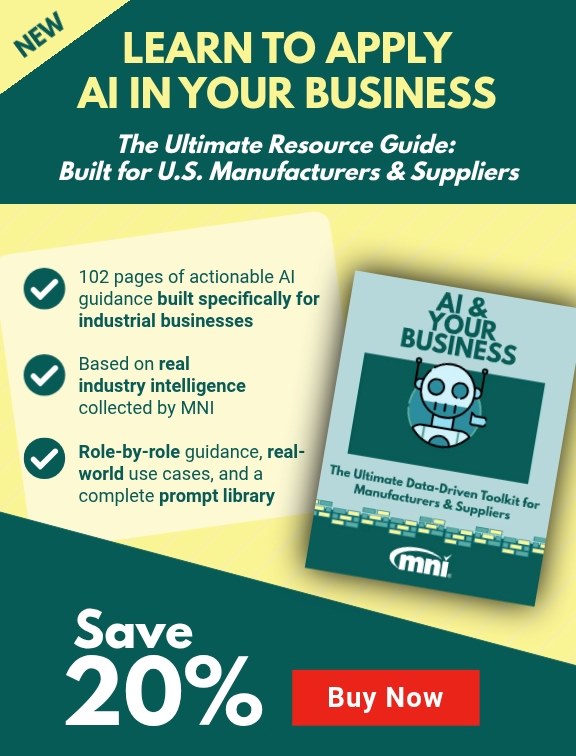
For a limited time get 20% off this essential resource for applying AI in your manufacturing business.
AI & Your Business: The Ultimate Data-Driven Toolkit for Manufacturers & Suppliers, published by MNI, is built on verified, first-party data collected directly from thousands of U.S. manufacturers and industrial suppliers. The guidance reflects how manufacturing organizations actually operate: lean teams, overlapping roles, local decision-making, and long operating histories.
The toolkit covers AI use by role, including sales, operations, HR, marketing, and office administration, with practical guidance and ready-to-use prompts designed for real manufacturing workflows. It also includes an appendix of exclusive MNI data on U.S. manufacturing structure, plus a role-based prompt library adapted for industrial environments.
