


The U.S. manufacturing sector is not only building factories but also building the future.
Manufacturing is a vital sector of the U.S. economy, contributing to innovation, productivity, and job creation. However, in recent years, manufacturing output and employment have faced challenges from global competition, technological change, and environmental regulations. Despite these headwinds, there is a surprising trend that suggests a bright future for U.S. manufacturing: the construction of new factories is soaring:
According to data from the Census Bureau released last week, construction spending by U.S. manufacturers more than doubled over the past year. For April 2023, the annual rate reached nearly $190 billion compared with $90 billion in June 2022, with manufacturing accounting for around 13% of non-government construction. This is the highest level of manufacturing construction spending since the data series began in 2002.
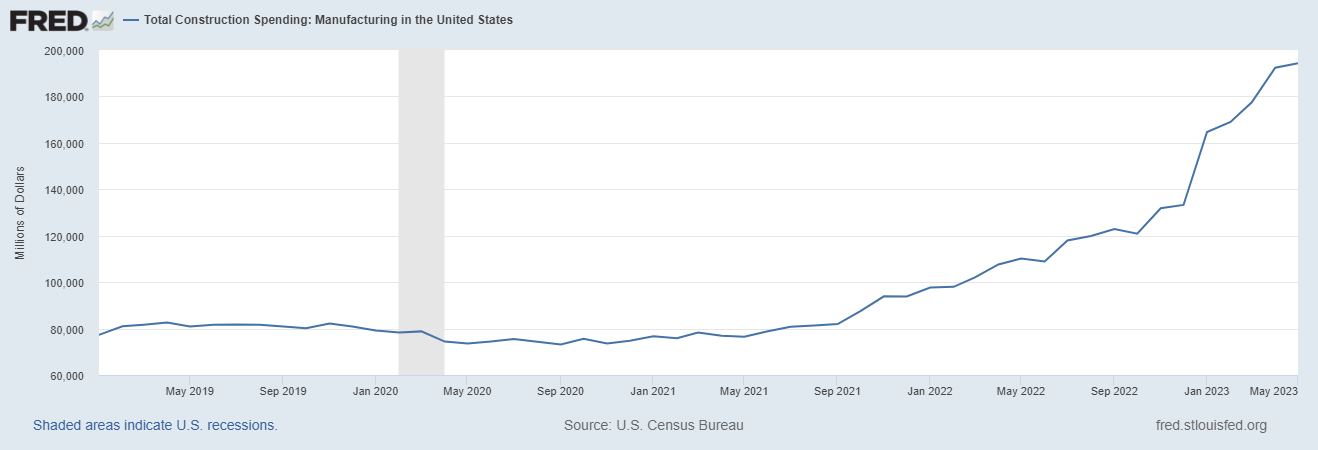
What is driving this surge in manufacturing construction? There are several factors that may explain this phenomenon, such as:
• The need to expand production capacity and modernize facilities to meet increasing demand and compete globally.
• The desire to reshore or nearshore manufacturing operations to reduce dependence on foreign suppliers and improve resilience.
• The availability of federal funding and incentives to support domestic manufacturing, especially in critical sectors such as semiconductors, pharmaceuticals, and clean energy.
• The emergence of new technologies and innovations that enable more efficient and flexible manufacturing processes.
Let's take a closer look:
The Chips Act This is a bipartisan legislation that was enacted in December 2022 to provide incentives and funding for domestic semiconductor production and research. The U.S. semiconductor industry has been facing a global shortage of chips that has affected various sectors, such as automotive, consumer electronics, and defense. The CHIPS Act aims to boost the U.S. competitiveness and resilience in this strategic sector by supporting the construction of new chip factories and the expansion of existing ones.
Inflation Reduction Act This is another bipartisan bill that was passed in March 2023 to address the rising inflation that has been plaguing the U.S. economy since the pandemic recovery. The Inflation Reduction Act provides tax credits and grants for businesses that invest in new equipment, machinery, and facilities that can increase their productivity and efficiency. The act also encourages the reshoring of manufacturing activities that were previously outsourced to lower-cost countries.
Pandemic-Induced Supply Chain Disruptions: The COVID-19 pandemic exposed the vulnerabilities and risks of relying on global supply chains for critical goods and materials. Many U.S. manufacturers faced shortages, delays, and higher costs due to the lockdowns, travel restrictions, and trade tensions that affected their foreign suppliers and customers. As a result, some U.S. manufacturers have decided to invest in building or expanding their domestic production capacity to reduce their dependence on overseas sources and to meet the growing demand from local markets.
For instance, Intel announced plans to invest $20 billion in two new factories in Arizona to boost its domestic chip production capacity. The company also said it will act as a foundry service provider for other chipmakers who want to manufacture their products in the U.S. Intel's CEO Pat Gelsinger said that "this is an inflection point for our industry" and that "we need a more balanced supply chain".
Another example is Ford, which is investing $11.4 billion in three new electric vehicle (EV) plants in Kentucky and Tennessee. The plants will produce batteries, EV components, and EV models such as the F-150 Lightning and the E-Transit van. Ford's CEO Jim Farley said that "this is our biggest investment ever in America" and that "we're future-proofing our U.S. auto industry".
Expanding Production Capacity and Modernizing Facilities One of the main reasons why manufacturers are investing in new or renovated facilities is to increase their production capacity and upgrade their equipment and technology. This is especially true for industries that have experienced a surge in demand due to the pandemic or other factors, such as food and beverage, medical equipment, personal care products, and e-commerce.
Reshoring Movement: Over the past few years, the concept of reshoring has gained traction, encouraging businesses to bring their production back to the U.S. from overseas locations. Rising wages in some foreign manufacturing hubs, coupled with logistical challenges, have made domestic production increasingly attractive.
Some of the benefits of reshoring or nearshoring include:
• Reducing transportation costs and lead times
• Improving quality control and customer satisfaction
• Enhancing flexibility and responsiveness to market changes
• Protecting intellectual property and national security
Technological Advancements: The manufacturing industry has undergone a technological revolution, with the advent of automation, artificial intelligence, and data analytics transforming traditional production processes. As businesses embrace advanced technologies, they often require updated or entirely new facilities to accommodate these innovations.
U.S. Manufacturing Boom & the Future of Manufacturing
What does this mean for the future of U.S. manufacturing? The construction boom could signal a potential revival of U.S. manufacturing in the coming years, as new factories become operational and start producing goods and services for domestic and foreign markets. This could also create more jobs, innovation, and competitiveness for the U.S. economy, as well as reduce its environmental footprint.
The resurgence in manufacturing construction is an encouraging sign for the U.S. economy and the manufacturing sector itself. It reflects a renewed confidence among businesses in the industry's future prospects and a willingness to invest in modernizing their operations. The implications of this trend extend far beyond just construction statistics:
Job Creation: Increased construction activity has a direct impact on job creation. The building of new manufacturing facilities creates employment opportunities not only in the construction industry but also in the manufacturing sector itself, driving economic growth and reducing unemployment rates.
Technological Advancements: The focus on constructing modern facilities indicates a commitment to adopting advanced technologies. As manufacturing becomes more technologically driven, it can enhance productivity, quality, and efficiency, making American manufacturers more competitive on a global scale.
Supply Chain Resilience: A robust manufacturing sector strengthens the domestic supply chain, reducing reliance on foreign imports. This not only makes the country more self-sufficient but also bolsters national security in times of global disruptions.
Economic Growth: Manufacturing has a multiplier effect on the economy. As the industry expands, it stimulates demand for raw materials, machinery, and other related services, fostering economic growth in various sectors.
Challenges Ahead
However, there are also some challenges and uncertainties that could hamper this optimistic outlook, such as:
The Availability of Skilled Workers The U.S. manufacturing construction boom will require a large number of workers along the way, with specialized skills and qualifications, such as engineers, technicians, electricians, plumbers, welders, etc. However, there is a shortage of such workers in the U.S., due to factors such as an aging workforce, low enrollment in STEM education, immigration restrictions, and mismatch between skills demand and supply. This could limit the speed and quality of construction projects and increase their costs.
Completion of Construction Projects The construction of new factories is a complex and lengthy process that involves multiple stages, such as planning, permitting, design, engineering, procurement, installation, testing, etc. Each stage can face delays or difficulties due to various reasons, such as weather conditions, regulatory hurdles, technical glitches, labor disputes, material shortages, etc. These could affect the completion time and budget of construction projects and reduce their expected benefits.
Market Conditions Certain assumptions and expectations about the future demand and supply of goods and services in domestic and foreign markets has fueled the construction boom so far. However, these assumptions and expectations may change over time due to various factors beyond the control of manufacturers, such as consumer preferences and technological innovations.
Supporting U.S. Manufacturing’s New Era
The accelerating construction of new manufacturing facilities not only signifies a resurgence for the industry but also calls for increased support, supplies, and resources to sustain and further propel this growth. Industrial companies seeking to capitalize on this momentum will require reliable partners to meet their expanding needs.
Platforms like IndustryNet become indispensable tools for connecting manufacturers with a diverse range of suppliers, fostering collaboration, and promoting innovation. As the manufacturing sector flourishes, this surge will create a ripple effect, offering opportunities for businesses to thrive and contribute to the nation's economic resurgence. The future of manufacturing in the U.S. holds immense promise and finding new suppliers on IndustryNet will play a crucial role in shaping this transformative journey.
Learn more at www.industrynet.com.
• Economic Innovation Group: https://eig.org/manufacturing-construction-boom/
• Census Bureau: https://www.census.gov/construction/bps/index.html
• Treasury Department: https://home.treasury.gov/news/press-releases/jy1580 https://home.treasury.gov/news/featured-stories/unpacking-the-boom-in-us-construction-of-manufacturing-facilities
• Wall Street Journal: https://www.wsj.com/articles/americas-factory-building-boom-93dfb8f5
• Bloomberg: https://www.bloomberg.com/news/articles/2023-06-01/factory-boom-sweeps-us-with-construction-at-record-190-billion
